












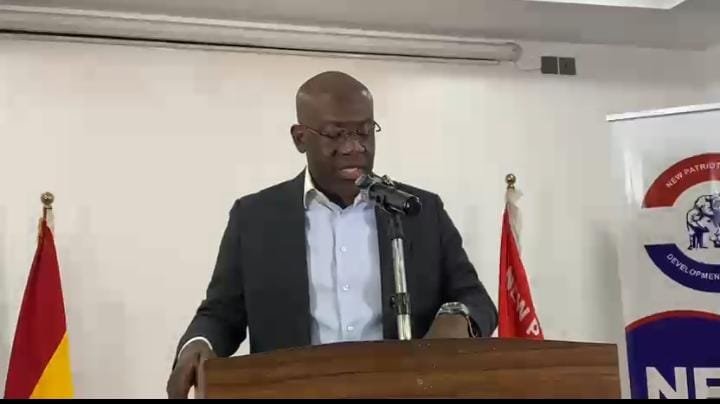
The New Patriotic Party (NPP) has criticised the government’s recently announced GH¢2 reduction in fuel prices, arguing that the measure offers little real relief to consumers and raising concerns about how it will be financed.
Member of Parliament for Ofoase-Ayirebi and Chairman of the NPP’s Policy Committee, Kojo Oppong Nkrumah, said the reduction, though welcomed by many motorists, would do little to ease the cost of living because fuel prices remain significantly higher than they were at the beginning of 2025.
His comments come after the government announced a GH¢2 per litre reduction in the pump prices of petrol and diesel for one month, describing the intervention as a temporary relief measure aimed at cushioning consumers from fuel costs.
Despite the reduction, transport operators under the Ghana Private Road Transport Union (GPRTU) have maintained that they are still considering an increase in transport fares, insisting that operational costs remain high.
Addressing the issue, Oppong Nkrumah argued that the reduction does not reflect the appreciation of the cedi and questioned the long-term viability of the intervention.
“You notice that despite the cedi strengthening from about 14 to 11, petrol is now still about 5.7% above the January 2025 level. And diesel is still now about 24% above the January 2025 level. Even with a full two Ghana cedi pass-through, diesel remains about 11.4% higher.”
He further contended that the latest reduction follows months of what he described as excessive fuel charges.
“We also notice that this two cedi reduction for one month comes after about a year of a one cedi per litre across all products. So this economics of you charge big and then you announce that you’ve reduced it marginally, it doesn’t work, it doesn’t fool anybody.”
Oppong Nkrumah also questioned the financial implications of the policy, saying the government must explain how it intends to absorb the cost.
“This one-month measure comes at a huge cost. If you add it to some of the things that the economic team has passed, it adds up to a huge cost. And there are questions about who is paying for that cost.”
Oppong Nkrumah also criticised recent amendments to the Energy Sector Recovery Levy (ESLA), claiming the changes amount to a new tax despite earlier assurances from the government.
The NPP says it will, in the coming days, provide a detailed assessment of the government’s fuel pricing measures and their impact on consumers, while continuing to press the government to disclose the source of funding for the temporary GH¢2 reduction.