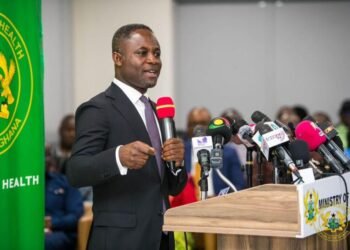





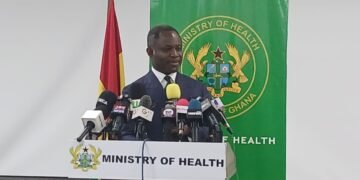




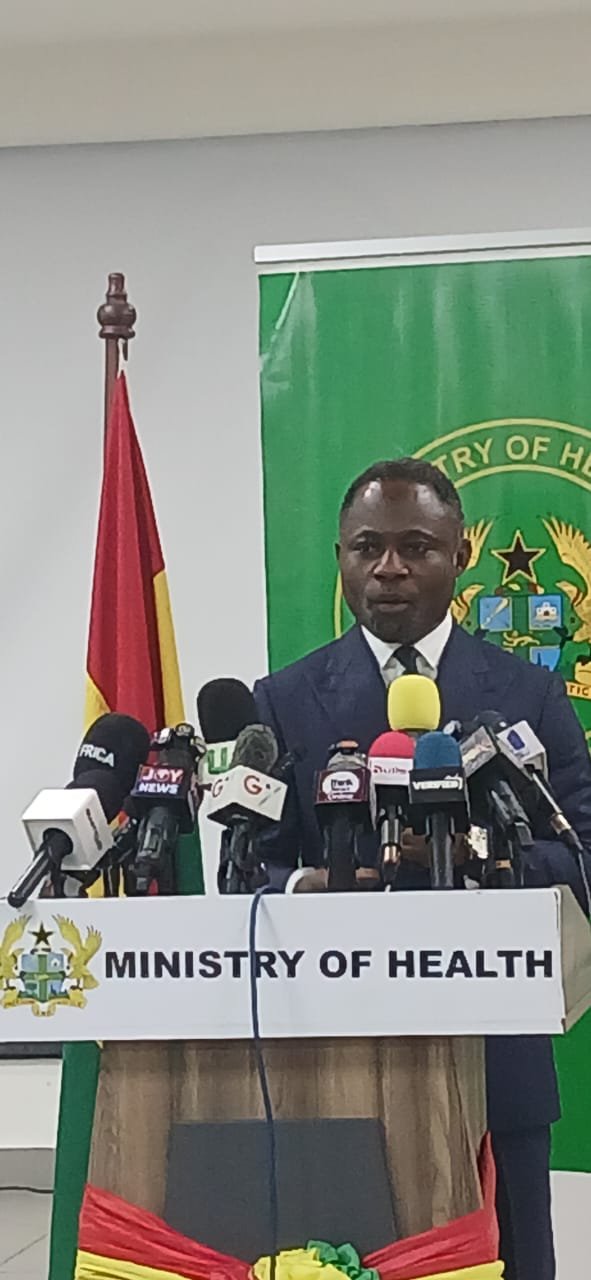
The Minister for Health, Kwabena Mintah Akandoh, has said the government’s Free Primary Healthcare programme will complement the National Health Insurance Scheme (NHIS) rather than replace it.
According to him, the emphasis on prevention and early detection under the programme will, over time, reduce the pressure on the NHIS by helping to prevent illnesses from becoming severe and costly to treat.
Mr. Akandoh disclosed this at a media briefing on Monday, September 7, where he provided an update on the implementation of the Free Primary Healthcare policy.
“The free primary health care is not a competitor to the National Health Insurance Scheme. And it does not come to replace the National Health Insurance, if anything at all.”
He described the programme as an important component of Ghana’s healthcare system that would work alongside the NHIS to improve access to basic healthcare and reduce the burden of disease.
“The free primary health care is the cheapest friend of the National Health Insurance Scheme.”
“So when we implement the National Health Insurance and the free primary health care well, in the long run, it will reduce drastically the pressure on the National Health Insurance system.”
The minister said the policy represents a shift in the country’s approach to healthcare, moving from a system that largely responds to illness to one that prioritises prevention and early detection.
“Under normal circumstances, somebody will wait until you fall sick. In some cases, you get worse. You end up at the hospital and you get treated.”
“What we are saying today is that we are now paying for the treatment, for the prevention.”
The programme provides a combination of curative, preventive and health-promotion services at the primary healthcare level.
The curative component covers common conditions including malaria, respiratory diseases and diarrhoea, while preventive services include screening for blood pressure, blood sugar, weight and selected cancers.
Mental health, maternal and child health, reproductive health, nutrition, physical activity, hygiene, sanitation and healthy lifestyle counselling are also included.
Mr. Akandoh, however, cautioned that the Free Primary Healthcare programme should not be interpreted as free healthcare at every level.
“And so we should also be cautioned that free primary health care does not mean free universal health care.”
He encouraged Ghanaians who qualify for the programme to seek care early instead of waiting for their conditions to worsen.
“Don’t wait till your condition gets worse because you don’t require any money to go to the hospital.”
The minister also warned health workers against demanding illegal payments from beneficiaries for services covered under the programme.
“I just say that we are not going to tolerate any form of illegal payment at these levels of healthcare.”
“No Ghanaians should pay for any that is part of their package.”
The Free Primary Healthcare programme is currently being implemented in 135 districts across Ghana, with the government targeting 150 districts in the first phase.
The broader goal is to extend the programme to every part of the country by the end of 2027.
The initiative is centred on bringing primary healthcare closer to communities through home visits, screening, health education and treatment of common illnesses.
The government believes the stronger focus on prevention and early detection will improve health outcomes while reducing the burden on higher-level health facilities and the NHIS.