



























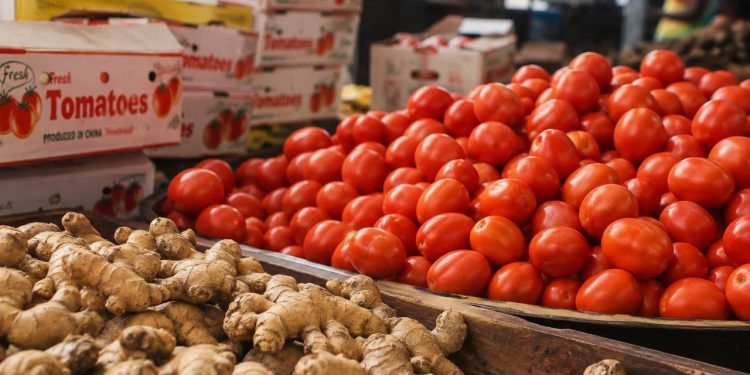
Ghana is spending at least US$168 million annually on fresh and processed tomato imports, while a disease outbreak has pushed the country’s dependence on imported ginger beyond 99 percent.
The figures, presented by researchers at the Council for Scientific and Industrial Research (CSIR), highlight the scale of Ghana’s import dependence in two key horticultural commodities and the foreign exchange costs associated with weak domestic production.
The researchers disclosed the figures during the second session of the 2026 Ministry of Environment, Science, Technology and Innovation (MEST) Visibility Webinar Series, held under the theme “CSIR’s Interventions on Tomato and Ginger.”
Dr Michael Kwabena Osei, Principal Research Scientist and vegetable breeder at the CSIR Crop Research Institute, said Ghana’s annual demand for fresh and processed tomatoes exceeds 1.4 million metric tonnes.
However, domestic production meets only about 15 to 18 percent of that requirement.
Fresh tomato imports, mainly from Burkina Faso, are estimated at between 100,000 and 120,000 metric tonnes annually, costing Ghana about US$18 million.
Processed tomato imports, largely from China and Europe, are equivalent to an estimated 400,000 to 450,000 metric tonnes of raw tomatoes and cost about US$150 million annually.
That puts Ghana’s annual expenditure on fresh and processed tomato imports at approximately US$168 million.
More than 60 percent of fresh tomato imports enter the country between November and April, when domestic production falls sharply during the dry season.
Dr Osei said the scale of the imports reflects a significant production gap, despite Ghana having more than 400,000 hectares of arable land suitable for tomato cultivation.
Average yields, however, remain between seven and 10 tonnes per hectare, compared with potential yields of 20 to 80 tonnes per hectare under improved varieties and better agronomic practices.
According to the researchers, the constraints include poor access to quality seed, limited irrigation, declining soil fertility, pests and diseases, and weak extension support.
Ghana’s dependence on imported planting material is another concern.
Dr Osei said more than 85 percent of tomato seed planted in Ghana is commercial hybrid seed, increasing production costs for farmers and exposing the sector to external supply pressures.
“A country that imports its seed will always import its food,” he said.
The researchers also pointed to underutilised irrigation infrastructure as a major constraint to year-round tomato production.
Of the 15,000 hectares covered by 22 public irrigation schemes, only about 9,000 hectares are currently in use.
Ginger imports
The situation in the ginger sector is even more severe.
Dr Osei said Ghana’s ginger demand increased from about 18,000 tonnes in 2020 to between 30,000 and 32,000 tonnes in 2025.
Domestic production suffered a sharp decline, leaving the country more than 99 percent dependent on imported ginger.
Ghana now spends approximately US$500,000 annually on ginger imports, mainly from China, Nigeria and Burkina Faso.
The supply disruption has also triggered a dramatic increase in prices.
A sack of ginger that sold for about GH¢250 in 2022 rose to around GH¢4,000 in 2025, and had reached approximately GH¢6,000 or more at the time of the webinar.
CSIR researchers say the bacterial wilt is soil-borne and can spread through infected planting material, poor drainage, heavy rainfall, monocropping and contaminated farm equipment.
They are proposing disease-resistant varieties, disease-free planting materials through tissue culture, stronger disease surveillance and improved farmer extension services as part of the recovery strategy.
Economic cost
The tomato and ginger figures highlight a broader challenge for Ghana’s agricultural economy.
Ghanaian culture insights
For tomatoes alone, US$168 million leaves the country annually to finance imports, despite significant domestic production potential.
In ginger, a disease outbreak has demonstrated how quickly a domestic agricultural value chain can become dependent on imports when production and research systems are unable to respond effectively.
CSIR researchers are therefore calling for stronger investment in certified seed production, irrigation, soil improvement, mechanisation and protected cultivation.
Dr Osei has also proposed the establishment of a Tomato Board by 2028 and a dedicated Horticultural Research Institute by 2030 to coordinate research, seed development, processing, financing and market integration.
The objective is to convert Ghana’s agricultural potential into commercially viable production – reducing the import bill, strengthening local value chains and retaining more foreign exchange within the economy.