























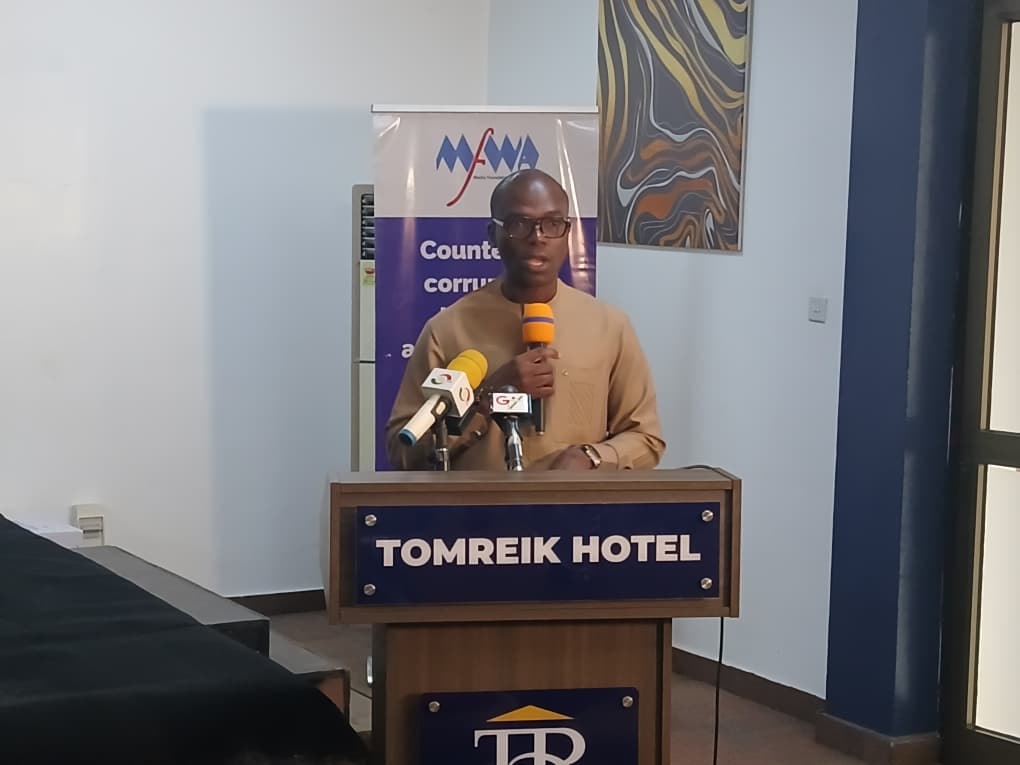
The Executive Director of the Media Foundation for West Africa (MFWA), Sulemana Braimah, has raised concerns over declining public confidence in Ghana’s anti-corruption efforts, warning of a growing trust deficit that could undermine democratic governance.
Speaking at a forum titled “Restoring Citizens’ Trust in the Fight Against Corruption in Ghana: The Role of the Media” on June 17, 2026, Mr. Braimah said that despite significant investments in anti-corruption laws and institutions, many citizens remain unconvinced that corruption is being effectively addressed.
He cautioned that trust is fundamental to democratic governance, stressing that without it, even strong laws and institutions may fail to deliver meaningful results.
“Trust is the cornerstone of any functioning democracy. Without it, even the most well-crafted laws and robust institutions will struggle to deliver meaningful change,” he said.
Mr. Braimah noted that Ghana has established several key anti-corruption bodies, including the Commission on Human Rights and Administrative Justice, the Economic and Organised Crime Office, the Financial Intelligence Centre, and the Office of the Special Prosecutor, alongside legislative frameworks such as the Right to Information Act and the National Anti-Corruption Action Plan.
However, he observed that public perception remains largely negative, citing findings from the 2025 Afrobarometer report, which suggests that many Ghanaians believe corruption has worsened and that confidence in anti-corruption institutions is weak.
He warned that perceptions play a critical role in shaping public behaviour, adding that loss of trust could discourage citizens from reporting corruption or believing in the possibility of reform.
“Perceptions matter profoundly. They shape behavior. When citizens lose trust, they become less likely to report corruption or believe change is possible,” he said.
Mr. Braimah further emphasised that journalism alone cannot resolve the corruption challenge, noting that effective accountability requires strong institutional action, ethical leadership, and active citizen engagement.
“Exposing corruption is only one part. Accountability requires institutions to act, leaders to show integrity, and citizens to demand change,” he added.
The forum was organised by MFWA in collaboration with CHRAJ, the National Commission for Civic Education (NCCE), and Transparency International Ghana.
It also marked the closing of the 8th Next Generation Investigative Journalism Fellowship.
The programme is supported by BMZ and co-financed by the European Union and SECO, and implemented by GIZ in partnership with Ghana’s Ministry of Finance.
Mr. Braimah expressed appreciation to partners for their continued commitment to promoting transparency, accountability, and active citizenship in Ghana.