
























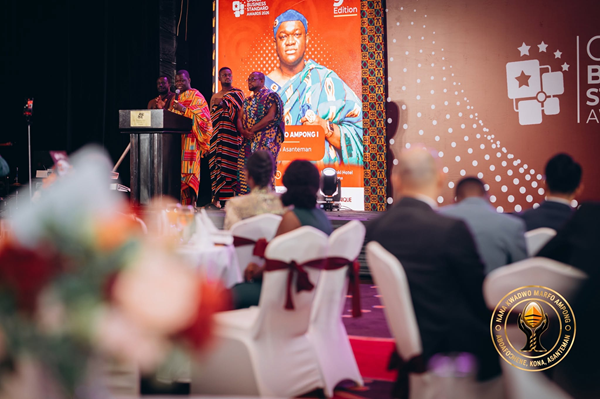
Aboafuohene of the Traditional Council of Kona within the Dumankwa-Nifa Kyidom Division under the authority of the Asantehene, Nana Kwadwo Marfo Ampong I, known in private life as Dr Maxwell Ampong, has called on Ghanaian businesses to move beyond resilience and focus on building systems and capabilities that can compete on the global market.
He said Ghanaian entrepreneurs had demonstrated remarkable resilience in navigating challenges, but stressed that resilience alone should not become a substitute for functional systems and institutions.
“Resilience is a virtue. Permanent dysfunction is not,” Nana Marfo Ampong said in a speech delivered at the Ghana Business Standards Awards at the Kempinski Hotel Gold Coast City in Accra on September 26, 2026.
According to him, the next step for Ghana was to convert the ingenuity developed through years of overcoming challenges into systems capable of delivering quality and consistency at scale.
“Only systems can give ingenuity scale,” he said.
Nana Marfo Ampong used the history of international measurement standards to illustrate the importance of trust in commerce.
He referred to the former International Prototype of the Kilogram, known as Le Grand K, noting that the global system of measurement depended on agreement over what constituted one kilogram.
He drew parallels with the traditional Akan system of goldweights, known as abrammuo, which were used by merchants to establish common measures in gold trading.
He said the traditional system demonstrated that Ghanaian identity and participation in global commerce did not have to be mutually exclusive.
“You do not have to abandon identity in order to trade with the world. You simply have to make sure that when somebody places gold on one side of the scale, the other side can be trusted,” he said.
According to him, standards make it possible for people and businesses that may never meet to conduct transactions based on trust.
He therefore urged Ghanaian businesses to view standards not simply as regulatory requirements or paperwork, but as tools for securing market access and expanding their operations.
“Made in Ghana tells the world where something came from. Standards help determine how far it can go,” he said.
“The world is our marketplace”
Nana Marfo Ampong challenged Ghanaian businesses to look beyond the domestic and African markets and position their products and services for international competition.
He said Ghana had the potential to export more food, pharmaceuticals, technology, intellectual property, professional services and locally owned brands.
“The world is our marketplace,” he said.
He, however, cautioned against assuming that international buyers would purchase Ghanaian products simply because they were made in Ghana.
“Patriotism may persuade someone to try a Ghanaian product once. Only quality will persuade a stranger to buy it again,” he said.
He explained that international buyers often rely on certification, laboratory results, traceability, audited accounts and clear specifications to determine whether they can trust a product or service.
He described trust as the “grammar” of money and said Ghanaian businesses needed to produce in a language that global markets could understand.
Nana Marfo Ampong also called on large companies, banks, universities and public institutions to support local businesses in meeting required standards instead of simply rejecting those that fall short.
He suggested that institutions should sometimes ask what could be done to help a Ghanaian business improve its processes, test its products, document its operations and obtain certification.
“That is how standards become instruments of industrial development rather than merely barriers to entry,” he said.
He urged the country to move from the mindset of “Buy Ghana because it is Ghanaian” to one where consumers and international buyers choose Ghanaian products because they meet high standards of excellence.
He said certification should ultimately be viewed as a passport to markets, capital, trust and scale.
Celebrating excellence
Nana Marfo Ampong also congratulated the honourees at the event, urging them to treat their recognition as a motivation to raise standards further.
“Rise and raise the measure again,” he told the award recipients.
Quoting an Akan proverb, he said: “Dua kontonkyi kuronkyi na ɛma yɛhunu odwomfo pa,” which he translated as, “It is the crooked piece of wood that reveals the master carver.”
He said Ghana was full of people capable of demonstrating excellence and urged the country to build an economy where locally produced goods and services could compete on the world stage.
Nana Marfo Ampong concluded by calling for a Ghana whose businesses were established locally but capable of gaining international recognition and trust.
“Made in Ghana. Measured against the global standards. And trusted by the entire world,” he said.