
























One of the least examined questions within the National Democratic Congress today concerns the future character of the office of National Chairman. Much of the discussion that eventually emerges around leadership transitions is usually framed around personalities, factions, regional calculations, and delegate arithmetic.
Yet such discussions often miss the more important question. Before asking who should become chairman, it is necessary to ask what kind of chairman the NDC is likely to require in the period ahead. Political offices do not exist in isolation.
Their significance changes according to the circumstances confronting the institutions they serve. The requirements of a chairman in opposition are not necessarily the requirements of a chairman in government. Equally, the requirements of a chairman during a period of political contestation are different from those of a chairman during a period of consolidation and succession management. The NDC now finds itself entering a stage where these distinctions matter.
For much of the last two decades, the party’s organisational life has been shaped by the influence of Johnson Asiedu Nketia. Whether one supported or opposed particular decisions taken during that period, few would dispute that he became one of the defining organisational figures in the history of the party.
His long tenure first as General Secretary and later as National Chairman coincided with some of the NDC’s most consequential moments, including electoral victories, defeats, internal transitions, and the party’s eventual return to government.
The result is that many observers have unconsciously come to associate the office of chairman with the particular qualities that he brought to it. Yet history suggests that political offices rarely remain static. Once a dominant political figure exits the scene, institutions often redefine the purpose of the office itself.
The question therefore is not merely who succeeds Asiedu Nketia, but whether the NDC’s next phase requires the same type of leadership that characterised the previous one.
There are reasons to believe that it may not. The party has returned to power under President John Mahama. The immediate challenge of recovering government has been resolved. The central questions now confronting the NDC concern governance, performance, continuity, and the management of political authority over time.
Every governing party eventually arrives at a point where its principal concern shifts from electoral mobilisation to institutional preservation.
Maintaining unity within government, balancing competing ambitions, preparing for future leadership transitions, managing relations between party and state, preserving ideological coherence, and protecting the long-term interests of the organisation become increasingly important.
These are not tasks that necessarily reward the loudest political voice or the most formidable organiser. More often, they reward figures capable of exercising influence through judgement, credibility, restraint, and authority.
This distinction is important because it changes the profile of the ideal chairman. In opposition, parties often elevate leaders who can organise resistance, energise supporters, and prosecute political battles. Governing parties, by contrast, frequently gravitate toward individuals who can provide equilibrium.
The office gradually becomes less about mobilisation and more about stewardship. Its occupant serves as a custodian of relationships, a guardian of institutional continuity, and a stabilising presence capable of commanding respect across different centres of power.
Such figures are relatively uncommon because political authority acquired through institutional trust is fundamentally different from authority acquired through factional strength. The former tends to endure longer and travel further within organisations.
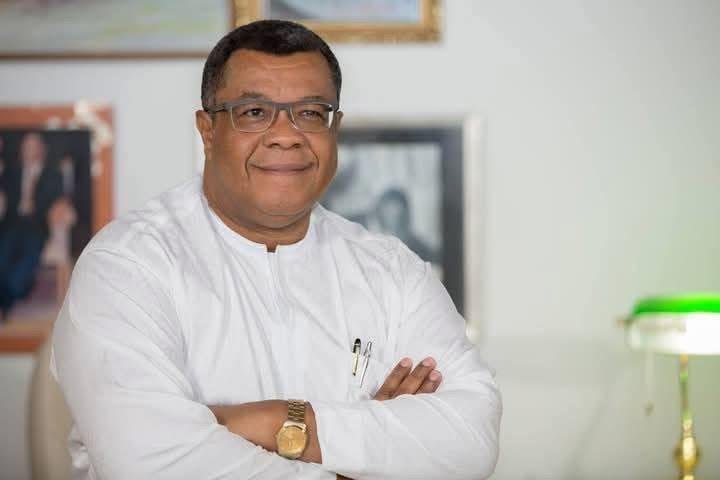
Viewed against that background, the growing attention being paid to Goosie Tanoh becomes easier to understand. His relevance to the discussion is not rooted primarily in ambition or visibility. It derives from the fact that he increasingly embodies many of the characteristics that governing parties historically seek during periods of consolidation.
Unlike many political figures whose influence is tied to a particular office, constituency, or faction, Tanoh’s standing has been accumulated over several decades across multiple domains of national life. His political experience spans the democratic transition, the formative years of the NDC, public policy, governance, private enterprise, and economic development. As a consequence, his authority derives less from organisational position than from a broader reservoir of political credibility.
This distinction becomes particularly significant when one considers his current role within government. As Presidential Adviser and the leading figure behind the 24-Hour Economy and Accelerated Export Development Programme, Tanoh occupies a position at the centre of the administration’s most important economic undertaking.
The significance of this extends beyond policy. It means that he operates within the practical realities of governance rather than the abstract language of politics.
He confronts questions of production, investment, exports, competitiveness, employment creation, industrial development, and implementation. In many respects, he sits at the intersection between political authority and economic delivery. For a governing party seeking to maintain alignment between its political structures and its governing agenda, such experience carries obvious value.
His relationship with the NDC itself is equally important. There are very few active political figures whose association with the party stretches across so many phases of its history. More importantly, there are few whose standing remains relevant across multiple generations of party members. Among veteran cadres and long-serving activists, he commands respect as one of the enduring figures of the political tradition from which the NDC emerged.
Among many younger members, he is increasingly associated with questions of national development and economic transformation rather than the internal rivalries that often define party politics. That ability to command recognition across different generations should not be underestimated. Political organisations frequently struggle to identify leaders capable of speaking simultaneously to their history and their future.
His participation in the party’s 2019 presidential primaries deserves consideration within this broader context. The significance of that contest was not ultimately electoral. Rather, it demonstrated that his relationship with the party remained active, contemporary, and rooted within its democratic processes. It brought him into direct engagement with delegates, organisers, and grassroots structures throughout the country while reaffirming his place within the evolving life of the NDC. The years since have strengthened rather than diminished that relevance through his increasing involvement in the government’s economic agenda.
None of this necessarily means that Goosie Tanoh will become National Chairman. Political outcomes are shaped by numerous variables, many of which remain unknowable until the moment arrives. What can be said, however, is that the conversation surrounding the future of the office is gradually moving in a direction that appears favourable to figures possessing his particular attributes.
If the party is entering a period where steady judgement matters more than political combat, where experience carries greater weight than factional influence, and where a leader must be respected across the organisation rather than by only one camp, then attention will naturally turn to a small group of individuals. Among those names, few combine seniority, government relevance, historical legitimacy, policy engagement, and cross-generational credibility as comprehensively as Goosie Tanoh.
For that reason, his place within any serious conversation about the future chairmanship of the National Democratic Congress is unlikely to diminish. If anything, it is likely to grow. Not because of the force of a campaign, but because of the changing requirements of the office itself.
As political parties mature, they often discover that the most important leadership decisions are not about who can win the next internal contest, but about who can best safeguard the institution through the period that follows. That is the question the NDC will eventually have to answer. It is also the question that increasingly places Goosie Tanoh at the centre of the discussion.