
















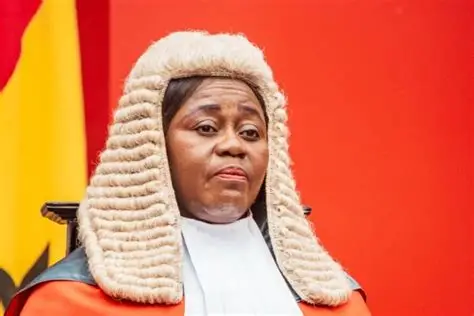
The ECOWAS Court of Justice has dismissed an application filed by former Chief Justice Gertrude Sackey Torkornoo challenging her suspension and eventual removal from office, dealing a major blow to her efforts to overturn the process through the regional court.
In a unanimous decision delivered on June 24, 2026, the three-member panel rejected all seven allegations brought against the Republic of Ghana and held that the removal process did not violate her rights under the African Charter on Human and Peoples’ Rights.
The Court found that the committee established to investigate petitions seeking her removal was lawfully constituted and that she was given a meaningful opportunity to be heard throughout the proceedings.
It further ruled that the President’s prima facie determination, made in consultation with the Council of State before formal proceedings commenced, was merely a preliminary constitutional step and did not amount to a hearing requiring her participation.
The Court also dismissed claims that she was denied representation during proceedings on May 15, 2025, noting that although she was absent, her legal counsel was present before the committee. The judges held that counsel’s decision not to participate could not be interpreted as a denial of representation.
Additionally, the Court rejected Torkornoo’s request for US$10 million in compensation for alleged reputational and moral damage, stating that no reparations could be awarded because no rights violation had been established.
The ruling effectively upholds the constitutional processes initiated by Ghanaian authorities that culminated in her removal from office.
The case stems from events that began in April 2025 when President John Dramani Mahama suspended Chief Justice Torkornoo under Article 146 of the 1992 Constitution after determining, in consultation with the Council of State, that a prima facie case had been established based on petitions seeking her removal.
A committee was subsequently constituted to investigate allegations of misconduct and recommend whether she should remain in office. Following the committee’s work and subsequent constitutional processes, she was removed as Chief Justice, becoming the first holder of the office in Ghana’s history to face and complete such removal proceedings.
Torkornoo challenged aspects of the process in Ghana’s courts and later turned to the ECOWAS Court, arguing that her suspension, the composition of the investigative committee and the removal proceedings violated her rights to a fair hearing, dignity and fair working conditions.
She also contended that the process subjected her and her family to public ridicule and damaged her professional reputation.
However, the ECOWAS Court found no evidence that Ghana had breached any of the rights she cited and concluded that the proceedings were conducted within the framework of the country’s constitutional and legal processes.
The judgment leaves intact all actions taken against the former Chief Justice and brings an end to her challenge before the regional court, although legal discussions surrounding the constitutional implications of the case are expected to continue.