


















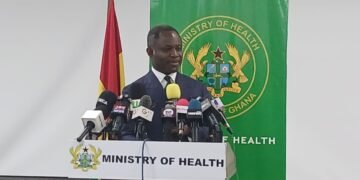



Media Liaison Officer to the Minister for Food and Agriculture, Samuel Huntor, has mounted a robust defence of the government’s Nkoko Nkitikiti Initiative, describing it as one of Ghana’s most impactful interventions in the poultry sector and dismissing criticisms from the opposition New Patriotic Party (NPP) and sections of the poultry industry.
Speaking on Burning Issues on Adom FM, Huntor questioned the basis of the NPP’s criticism of the government’s decision to distribute free birds to 60,000 beneficiary households under the Nkoko Nkitikiti Initiative, a flagship component of the broader Feed Ghana Programme aimed at revitalising domestic poultry production and strengthening national food security.
According to Huntor, the current administration’s approach focuses on increasing household and commercial poultry production by directly supporting farmers with birds and other inputs to expand local production capacity.
He argued that the programme is already yielding positive results, claiming that it has stimulated local poultry production, increased egg output and contributed to greater availability of poultry products on the domestic market.
Huntor maintained that unlike previous interventions, the Nkoko Nkitikiti Initiative is designed to create sustainable production at the community level while supporting the government’s broader agenda of reducing Ghana’s dependence on imported poultry products.
Addressing criticisms from the NPP Minority, Huntor contrasted the current intervention with policies implemented under the previous administration.
He alleged that the previous NPP government procured approximately 10,000 battery cages at significant public expense and distributed them to selected beneficiaries, including some NPP Members of Parliament and party officials. Huntor further claimed that some of those beneficiaries later disposed of the equipment instead of using it to expand poultry production. These allegations have not been independently verified, and no response from the individuals mentioned was available at the time of his remarks.
He argued that the more important question should be the measurable impact of any government intervention on local poultry production rather than the form of support provided.
According to Huntor, the Nkoko Nkitikiti Initiative has delivered stronger outcomes within a relatively short period compared with previous poultry support programmes.
Huntor further claimed that Ghana’s poultry industry has experienced significant growth under the current intervention, resulting in increased egg production.
He stated that whereas Ghana previously relied on imported eggs to supplement local demand, the country is now exporting eggs in commercial quantities to neighbouring Burkina Faso, which he attributed to improvements in domestic production driven by the Nkoko Nkitikiti Initiative.
Official trade and production data would ultimately provide the basis for independently assessing these claims.
Stakeholder Consultation Dispute
Huntor also rejected assertions by the NPP Minority and the Poultry Farmers Association of Ghana that stakeholders were excluded from developing the Poultry Revitalisation Programme under the Feed Ghana policy.
According to him, all major stakeholders within the food and agriculture sector were invited to participate in the Feed Ghana Policy Validation Workshop held at Oak Plaza Hotel in Accra.
He noted that during a discussion on Burning Issues, both the NPP Minority spokesperson on Food and Agriculture and the President of the Poultry Farmers Association reportedly acknowledged participating in the validation workshop, which Huntor argued contradicts claims that the sector was excluded from policy formulation.
Progress of the Nkoko Nkitikiti Initiative
Providing an update on implementation, Huntor said the initiative has expanded rapidly since its launch in October 2025.
According to him:
- The programme aims to support 60,000 households nationwide.
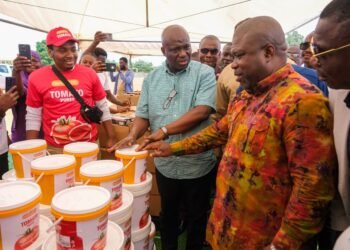
- Government has distributed 10,000 birds in each constituency across eleven of Ghana’s sixteen regions.
- Distribution is expected to continue in the remaining northern regions during the next phase of implementation.
He argued that achieving this level of rollout in less than one year demonstrates the government’s commitment to rebuilding Ghana’s poultry industry and strengthening food security.
Bechem Poultry Processing Facility
Huntor also provided an update on the construction of a modern poultry processing facility at Bechem.
According to him, once completed, the integrated facility will have the capacity to process approximately 6,000 birds per hour and will include:
- Modern cold storage facilities.
- A hatchery.
- Feed processing plants.
- Rendering facilities for poultry by-products.
- Silos for maize and soybean storage.
He said the facility is expected to strengthen the poultry value chain by reducing post-harvest losses, supporting commercial poultry farmers and creating employment opportunities while enhancing value addition within Ghana’s agricultural sector.
Analysis
The Nkoko Nkitikiti Initiative represents one of the government’s flagship agricultural interventions under the Feed Ghana Programme. Its stated objective is to reduce Ghana’s dependence on imported poultry products by increasing domestic production through direct support to farmers and households.
Supporters argue that the programme addresses long-standing constraints facing the poultry industry, including limited access to starter stock, high production costs and inadequate processing infrastructure. They contend that combining bird distribution with investments in processing facilities and feed infrastructure offers a more comprehensive approach than previous interventions.
Critics, however, have questioned aspects of implementation, beneficiary selection and sustainability. They have also called for greater transparency regarding programme outcomes and expenditure. Assessing the initiative’s long-term success will ultimately depend on independently verifiable indicators such as increases in poultry production, employment, farmer incomes, reductions in imports and official export data.
For Huntor, however, the programme’s nationwide rollout, ongoing infrastructure investments and reported improvements in local production demonstrate that the Nkoko Nkitikiti Initiative is beginning to reshape Ghana’s poultry sector.
He maintains that political criticism should be measured against tangible outcomes and that the government’s focus remains on expanding domestic production, improving food security and building a more competitive poultry industry.