





















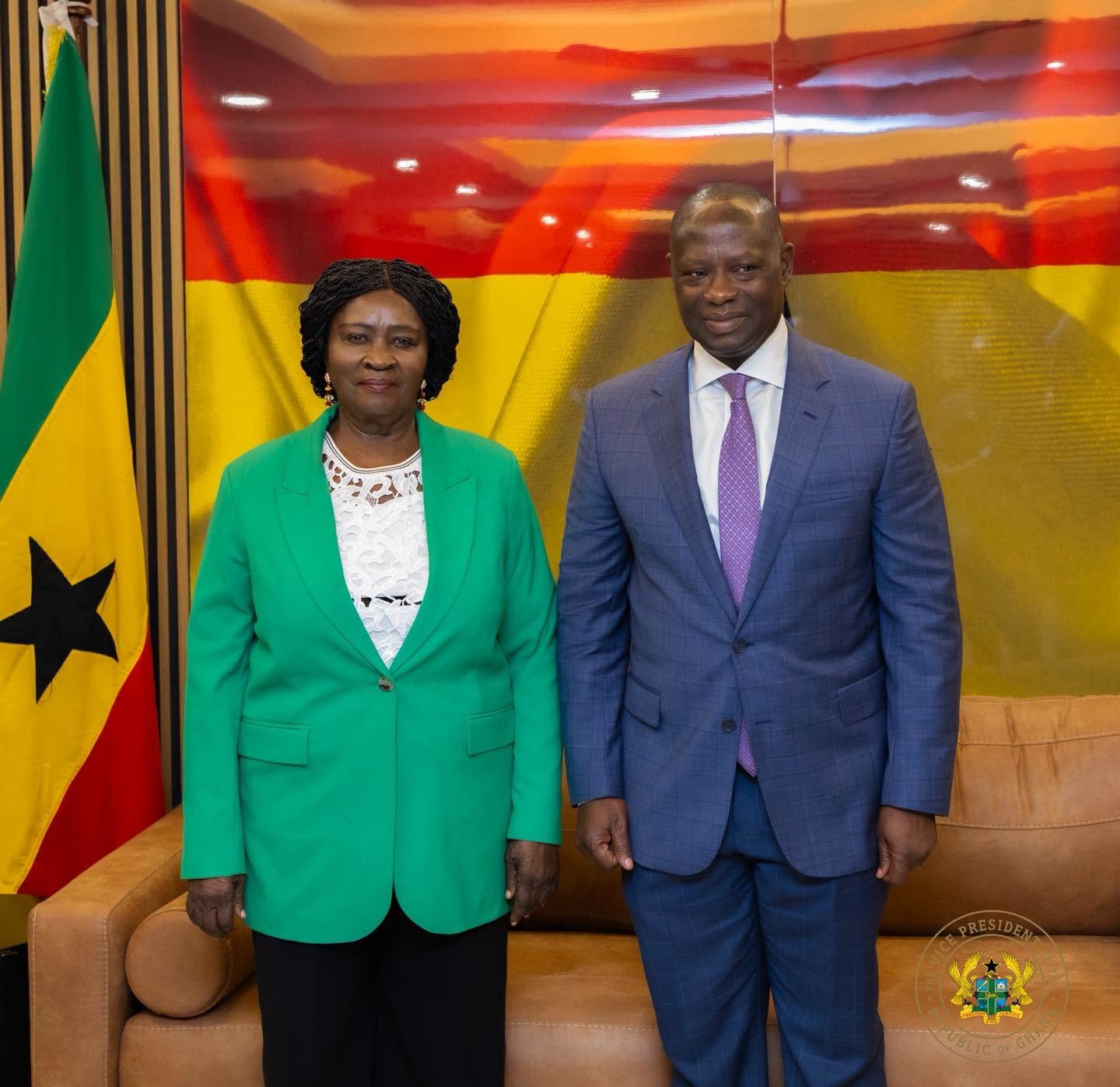
Vice President Prof. Jane Naana Opoku-Agyemang has called for stronger collaboration among government institutions to harness science, technology and innovation to drive Ghana’s development agenda.
The Vice President made the call during a visit to the Ministry of Environment, Science, Technology and Innovation (MESTI), where she was received by the Acting Minister, Emmanuel Armah-Kofi Buah, the Chief Director, management and heads of agencies under the Ministry.
During the engagement, MESTI outlined its mandate and oversight responsibilities over key institutions including the Council for Scientific and Industrial Research (CSIR), Ghana Atomic Energy Commission (GAEC), Environmental Protection Authority (EPA), National Biosafety Authority and the Nuclear Regulatory Authority.
The Ministry explained that these institutions play critical roles in advancing scientific research, protecting the environment, promoting technological innovation and ensuring sustainable management of Ghana’s natural resources.
Officials also highlighted progress made in implementing government’s environmental and industrial transformation agenda.
Among the initiatives mentioned were the Circular Economy Policy on plastics, the National Foundry and Machine Tools Project, promotion of green jobs and clean cooking technologies, electronic waste management programmes, climate-smart agricultural research and strengthened environmental regulation.
The Ministry further provided updates on efforts towards establishing a Ghana Space Agency and Ghana’s participation in international carbon market initiatives under the Paris Agreement.
Addressing the gathering, Prof. Opoku-Agyemang stressed the need for effective implementation, monitoring and evaluation of government policies to ensure they translate into tangible benefits for citizens.
“Effective governance requires translating policy into implementation and ensuring continuous monitoring and evaluation so that public policies deliver measurable improvements in the lives of Ghanaians,” she said.
She emphasized the importance of public education in achieving environmental sustainability, particularly in the wake of recent flooding incidents across parts of the country.
According to her, while enforcing environmental laws remains critical, sustained education is needed to encourage responsible behaviour and compliance among citizens.
The Vice President also highlighted the growing impact of climate change on Africa, noting that although the continent contributes relatively little to global emissions, it continues to experience severe consequences.
She said Ghana must continue to play an active role in international climate negotiations while positioning itself to benefit from global climate financing opportunities.
Prof. Opoku-Agyemang encouraged MESTI to deepen collaboration with other sectors of government to promote local manufacturing, create jobs, strengthen research commercialization and support Ghana’s industrialization drive.
She further called for stronger measures to protect public lands from encroachment and improve environmental governance to safeguard national assets.
The Vice President commended the Acting Minister, management and staff of MESTI for their commitment and reaffirmed government’s support for initiatives aimed at advancing science, technology and innovation for national development.
The Ministry identified funding constraints, shortages of scientific personnel, ageing laboratory infrastructure and the need to strengthen environmental legislation as some of the key challenges affecting its operations.