


























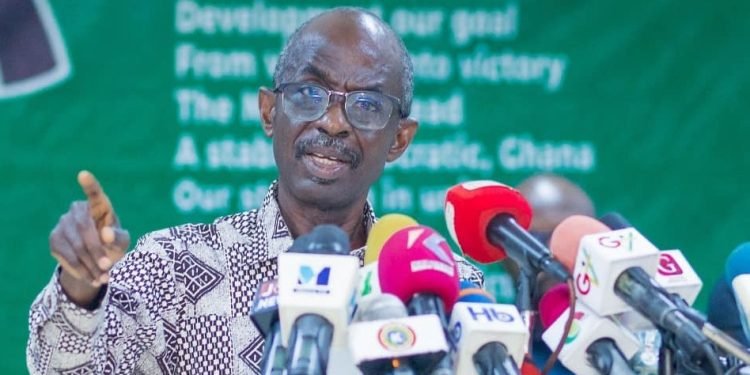
The National Chairman of the ruling National Democratic Congress (NDC), Johnson Asiedu Nketia, has mounted a strong defence of the party’s directive requiring government appointees to resign before contesting internal positions, amid growing resistance from some quarters.
Speaking on Lambussie FM during his Thank You Tour of the Upper West Region, Mr. Asiedu Nketia said the policy is not punitive but a necessary reform to restore balance within the party and government.
He explained that the decision was reached after careful internal consultations, following concerns that a concentration of roles among a few individuals was limiting opportunities for other party members and affecting organisational efficiency.
President John Dramani Mahama, he noted, has appointed a significant number of party faithful into government, a move he described as generous but one that has also exposed structural gaps within the party.
According to him, combining government responsibilities with active party leadership roles has proven impractical, often leading to overburdened officials and poor participation in party activities.
“People cannot effectively serve two demanding masters at the same time,” he indicated, adding that the inability of some office holders to attend meetings has already begun to affect decision-making within party structures.
Mr. Asiedu Nketia argued that the directive is also a matter of fairness, questioning why a few individuals should continue to occupy multiple influential positions while others remain sidelined.
However, his remarks come at a time when sections of the party are openly pushing back against the directive.
Information reaching Overseer Media suggests that several government appointees are quietly mobilising to contest key party positions without stepping down, in defiance of the six-month resignation requirement.
The situation has sparked frustration among some party executives, who warn that failure to enforce the rule could weaken the authority of the party’s leadership.
Critics within the NDC say allowing such defiance would reduce the leadership to mere spectators, insisting that the guidelines—adopted by the Functional Executive Committee and approved by the National Executive Committee—must be upheld.
Some have gone further to describe attempts to combine both roles as a sign of entitlement.
Others within the party, however, see the directive differently.
They argue that the rule risks excluding experienced figures and point to past instances where leading members successfully combined party and public offices.