



















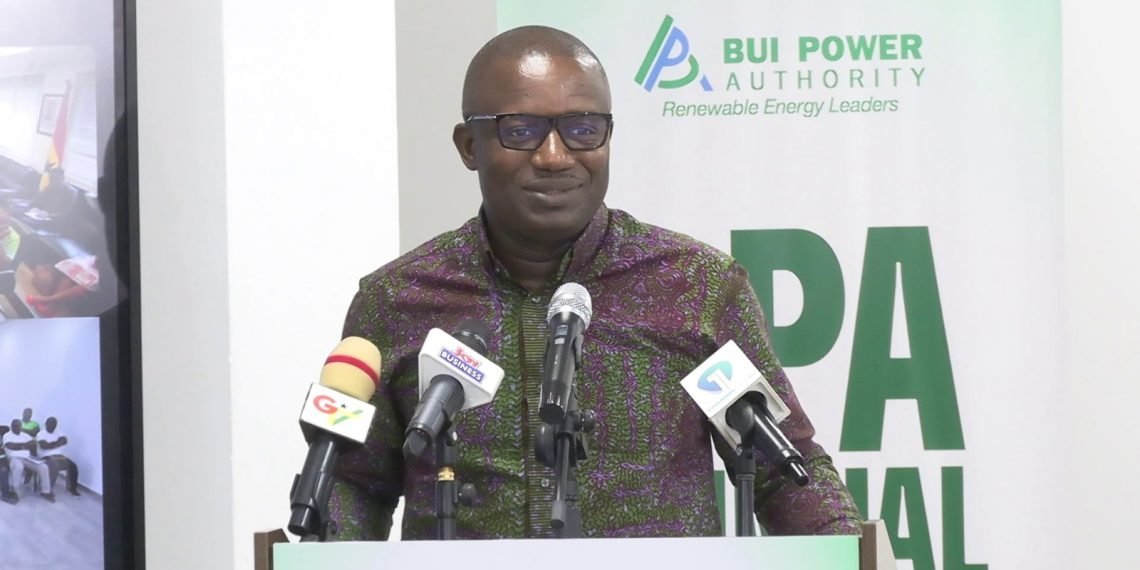
Minister for Energy and Green Transition, Dr John Abdulai Jinapor, has called for aggressive revenue collection across Ghana’s power sector, particularly from state-owned institutions that are not exempt from paying electricity bills.
According to the minister, improving revenue collection is critical to restoring financial stability across the electricity value chain and strengthening the financial position of power producers such as the Bui Power Authority (BPA).
Speaking at the BPA’s 2025 Annual Stakeholders’ Meeting, Dr Jinapor said the failure of some institutions to settle their electricity bills places an unfair burden on consumers who pay regularly.
“You have ten people, six people are paying, four are not paying.
It means that the six have to pay for the remaining four and so we have to be very aggressive when it comes to collection,” he said.
He specifically urged state-owned institutions that are not covered by government’s electricity payment exemptions to make adequate budgetary provisions and settle their bills.
Dr Jinapor questioned why some public institutions are able to secure funds to purchase diesel to operate during power outages but fail to pay their electricity bills when supply is restored.
“When the lights go off, these state-owned institutions get money to buy diesel.
But when the lights are on and you want them to pay, they rather want only the private people to pay,” he stated.
The minister said although the Bui Power Authority recorded a strong financial performance, including a profit of about US$62.2 million, its cash flow remains constrained by delayed payments from its main off-taker, the Electricity Company of Ghana (ECG).
He said the situation highlights the need to improve revenue collection throughout the sector.
“Whilst you are seeing a good profit, you are also making provision for impairment and that creates a problem.
It boils down to revenue collection by your off-taker, primarily ECG,” he said.
Dr Jinapor disclosed that the Ministry of Energy and Green Transition, together with the Public Utilities Regulatory Commission (PURC), is working with ECG to improve collections and ensure greater transparency in the distribution of sector revenues.
The minister also disclosed that ECG is introducing a technology-driven meter reading system aimed at improving billing and revenue collection.
Under the new system, young people equipped with handheld devices will be able to remotely read electricity meters without necessarily entering customers’ homes, after which bills will be generated and sent directly to consumers’ mobile phones.
Dr Jinapor said the initiative forms part of broader efforts to reduce billing challenges and strengthen revenue mobilisation.
Beyond revenue collection, the minister urged state-owned energy institutions to exercise greater discipline in their expenditure.
He cautioned that improved revenue mobilisation would not resolve the sector’s challenges if institutions continued to spend resources inefficiently.
“Even if we collect the money and we dissipate the money and use the money on frivolous expenditure, then we are going to have a problem,” he said.
He reiterated the government’s commitment to reforms aimed at restoring financial sustainability in the energy sector, including the cash waterfall mechanism and the Energy Sector Recovery Programme.
Dr Jinapor also criticised the practice of announcing electricity subsidies without making adequate budgetary provisions to reimburse power utilities.
He cited the COVID-19 free electricity programme, arguing that payments owed to utilities were delayed for several years.
“That money was only paid last year.
From 2020, it sat on ECG’s books till 2025. I’m not against subsidy, but I’m saying that when you provide for that subsidy, pay for it as a government,” he said.
He warned that when government fails to reimburse utilities for subsidies, the resulting financial burden ultimately affects the wider electricity sector and consumers.
Dr Jinapor commended the Bui Power Authority for exceeding its generation target and expanding its renewable energy portfolio.
He noted that BPA has increased its solar generation capacity from 55 megawatts to 105 megawatts and has also opened a battery energy storage system.
However, he urged the authority to place greater emphasis on battery-backed renewable energy projects to address Ghana’s evening peak demand.
“Our challenge is not daytime energy production or consumption. Our challenge is in the night,” he said.
He explained that increased battery storage would enable excess solar power generated during the day to be stored and supplied during periods of high evening demand.
The minister said BPA’s reported revenue of about US$145 million and its growing asset base demonstrate its potential to become increasingly self-financing if revenue collection across the power sector improves.