



























BOST Energies Limited has dismissed reports alleging fuel contamination at its Kumasi Depot, describing the publications as false and misleading.
In a statement on Monday, June 22, the company said the claims misrepresented an incident involving a tanker truck suspected of carrying adulterated petroleum products to the depot.
According to BOST, the tanker, with registration number GN 8887-18, was flagged during routine operational and quality assurance checks after personnel detected anomalies in the product it was carrying.
The company said samples were immediately taken for internal testing, which showed that the fuel did not meet the required specifications.
To verify the findings, additional samples were submitted to an independent third-party laboratory. The company said the external assessment confirmed that the product was off-specification.
Following the confirmation, BOST notified the National Petroleum Authority (NPA) and impounded the tanker in line with regulatory requirements. The company added that administrative and regulatory action is being pursued against the driver and transporter involved.
BOST stressed that the incident did not result in any contamination of fuel stored at the depot, noting that no product from the tanker was discharged into its storage or distribution systems.
“The detection of the off-specification product is a clear demonstration of the effectiveness and robustness of the quality assurance systems and operational controls in place,” the company stated.
It further assured the public that the integrity of products at the Kumasi Depot was never compromised and urged the public to disregard reports suggesting otherwise.
“Accordingly, the public is advised to disregard any reports suggesting that fuel contamination occurred at the Kumasi Depot. Such assertions are unfounded and fail to accurately reflect the circumstances of the incident,” the statement added.
BOST reaffirmed its commitment to maintaining high standards of quality, safety and operational excellence, while continuing to work with regulatory authorities to safeguard the integrity of petroleum products across the supply chain.
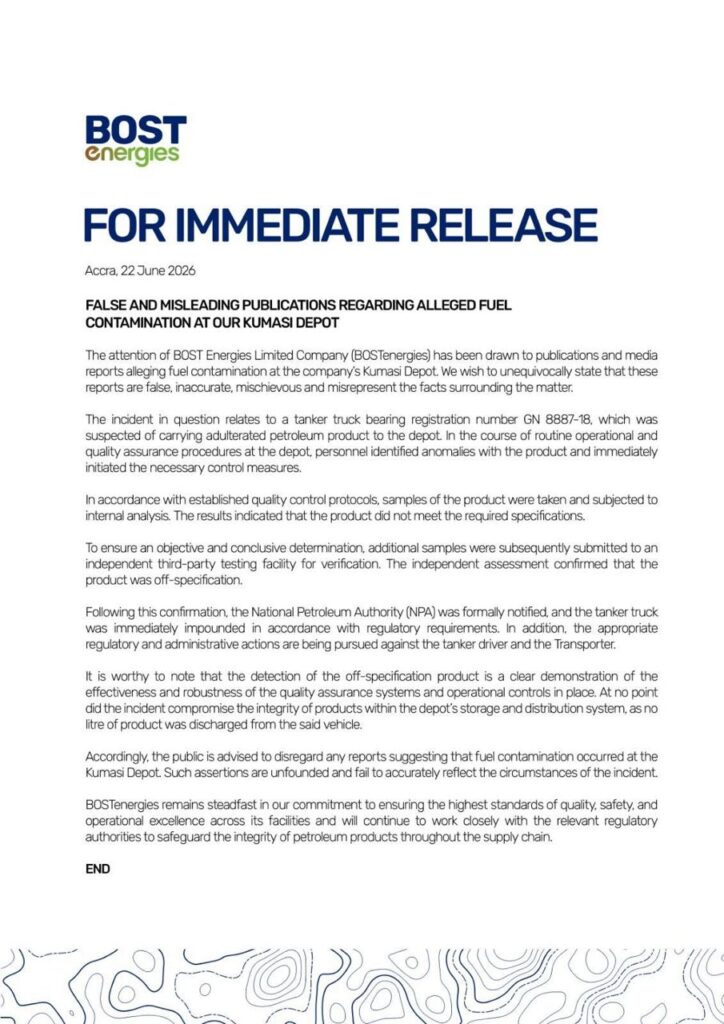
Below is a copy