






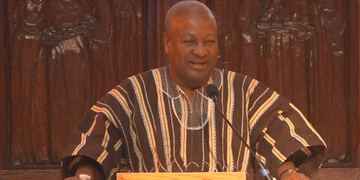


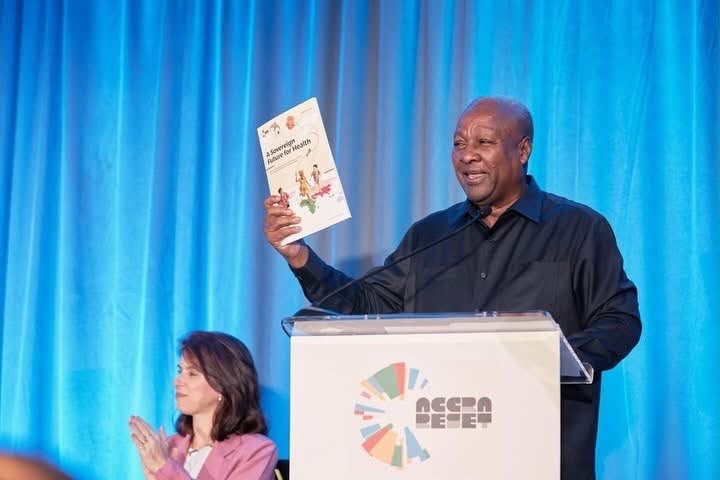
President John Dramani Mahama has called for a major change in the way international development partnerships work. He wants countries in the Global South to have more control over their own development priorities.
He also wants those countries to build the financial and productive capacity needed to support those priorities. President Mahama made the call in New York on Monday, September 21, 2026.
He was speaking at the Accra Reset; Global Reset Dialogue, held during the 81st United Nations General Assembly.
The event brought renewed attention to the future of development cooperation. It also marked the launch of A Sovereign Future for Health.
The report was produced by the Accra Reset High-Level Panel on Reform of the Global Health Architecture and Governance. It sets out five broad shifts and 10 recommendations.
The proposals seek to strengthen national capacity, improve regional cooperation and support global public goods.
President Mahama said the Accra Reset began a year ago against the background of a changing and shrinking aid system.
He said countries should not have their development plans depend too heavily on decisions made by donors.
The President linked the issue to the history of political independence. He recalled the 1955 Bandung Conference, where 29 countries gathered to demand a stronger voice in global affairs.
Mahama said political independence did not automatically give countries control over global trade, finance and health governance. He said this gap remains a challenge for many countries today.
“For decades, nations of the Global South have been asked to own the results of health and development programmes, while others retain the control,” he said.
The President also criticised the way “country ownership” has been applied in development cooperation.
He referred to the 2005 Paris meeting, where country ownership became a guiding principle of development cooperation.
“Fifty years later, in 2005, the world met in Paris and crowned ‘country ownership’ as the guiding principle of development cooperation. It was a pleasant phrase. But in truth, we were handed a broken cauldron; we were asked to own a soup cooked entirely in someone else’s kitchen!”
For President Mahama, genuine ownership requires real control. “Today, through the Accra Reset, we declare unequivocally that there can be No Ownership Without Control,” he stated.
He, however, added an important condition. Greater control, he said, must come with stronger accountability.
President Mahama called on governments to improve fiscal management, fight corruption and account for public resources.
“If we demand control, we must earn it through uncompromising domestic accountability,” he said.
He described this balance as the basis for a New Global Bargain.
“This is the bedrock of our New Global Bargain: responsibility matched by authority; authority backed by real productive capability; and every partner held accountable for their promises,” he said.
The President also stressed that greater self-reliance does not mean cutting ties with international partners.
He proposed what he called “pragmatic interdependence.” Under this model, countries would work together while also building their own capacity to produce and finance essential services.
“Stronger, self-reliant Southern partners are not a threat to the Global North,” he said. “On the contrary, resilient health systems in Africa and Asia make the entire world safer for all of us.”
The Accra Reset report includes proposals for sustainable health financing and stronger regional institutions.
It also covers local health manufacturing, better procurement systems and independent accountability. President Mahama said the focus must now shift from ideas to action.
Ghana and the Presidential Council are expected to work with international partners to turn the recommendations into country-level compacts.
The President also called for cooperation with institutions in Brazil, India, Indonesia, the Gulf and Africa. The proposed partnerships will connect research, regulation, manufacturing and distribution.
President Mahama said the goal is to build a system where countries can shape and finance their own priorities while remaining part of a strong international partnership.
The Accra Reset, he said, is intended to create greater capacity, stronger accountability and more balanced development cooperation for countries in the Global South.