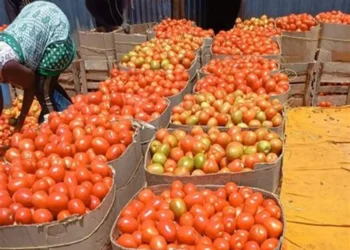























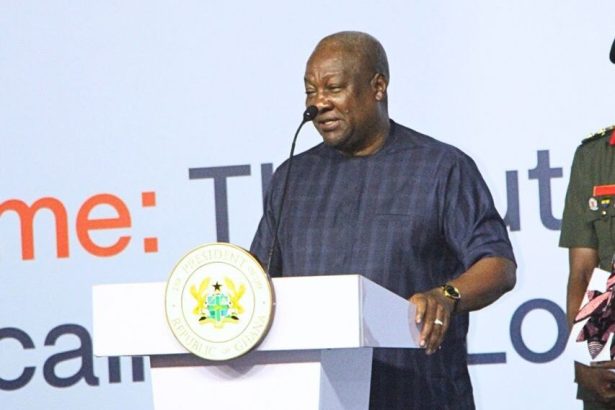
President John Dramani Mahama has revealed that Ghana will expand tomato production and invest in processing capacity to reduce reliance on imports and stabilise the local market.
This follows growing concerns over the country’s dependence on imported tomatoes and recent disruptions affecting Ghanaian traders in Burkina Faso, which exposed vulnerabilities in the supply chain.
Speaking at the Kwahu Business Forum in Mpreaso in the Eastern Region on Saturday, April 4, 2026, the President outlined plans to develop 60 hectares of irrigated farmland to support year-round tomato cultivation.
He stressed that increasing production alone will not solve the problem unless it is matched with adequate processing infrastructure.
“It is not enough to grow tomatoes. It is necessary to put in place processing capacity so we will not have tomato glut like other products,” he said.
President Mahama expressed frustration over Ghana’s continued importation of tomatoes despite having favourable conditions for local production.
“Ghana has the land, the water and the sunshine, yet we continue to depend on others. That is a national shame,” he stated.
He further questioned the country’s rising import bill, noting that large sums are spent annually on food items that could be produced locally.
“Why should we be spending about $3 billion on imports, much of it on food we can grow ourselves?” he asked.
He pointed to Burkina Faso as an example, noting that despite its challenging climate, it is able to produce and export tomatoes to Ghana.
The President said the new initiative is aimed at boosting local production, reducing post-harvest losses, and creating a more resilient agricultural sector.
Also speaking at the forum, Minister for Trade, Agribusiness and Industry, Elizabeth Ofosu-Adjare, underscored the need for Ghana to leverage its position under the African Continental Free Trade Area to drive industrial growth.
“Ghana carries a particular responsibility to show what intra African trade can deliver in practice,” she noted.
The initiative is expected to improve food security, support farmers, and reduce the country’s dependence on imports while strengthening Ghana’s agribusiness sector.