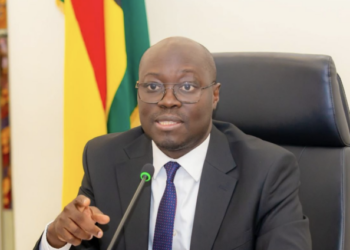


















The Chief Executive Officer of the Minerals Commission, Mr Isaac Andrews Tandoh, has defended the termination of Owere Mines’ mineral rights, insisting that the decision followed due process after years of alleged non-payment of annual mineral rights fees.
Speaking at a press conference, Mr Tandoh said the Commission had repeatedly given the company opportunities to settle its outstanding obligations but it had failed to comply with several notices issued over the matter.
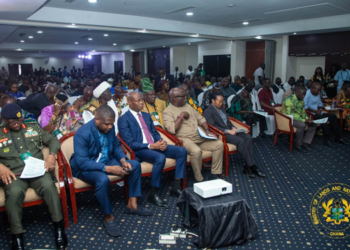
He said the Commission invited the media to outline the sequence of events leading to the termination and respond to claims made by the company following an earlier press release.
“We intend to place the full sequence of events before the people of Ghana so they may make a firm and informed decision on this matter,” he said.
Mr Tandoh stressed that mining leases and prospecting licences came with statutory obligations that all companies were required to fulfil.
“A mineral right is not a gift. It’s not an inheritance. It is a privilege conferred by the state on terms, and those terms must be honoured,” he stated.
He maintained that no company, whether locally or foreign-owned, could retain rights over the country’s mineral resources without paying the required fees.
Mr Tandoh traced the dispute to January 2010, when Owere Mines acquired a mining lease covering 595 cadastral blocks.
He said Section 24 of the Minerals and Mining Act, 2006 (Act 703), required the company to pay annual mineral rights fees to the Commission.
According to him, the company failed to meet the obligation, prompting the Commission to issue a notice to remedy the breach on May 28, 2020, under Section 68(2) of Act 703 and Regulation 200(3) of the Minerals and Mining (Licensing) Regulations, LI 2176.
At the time, he said, the company owed more than US$4 million.
The Commission’s CEO explained that following the transactional takeover of the company by BCM Investments, the company proposed an instalment arrangement to settle the outstanding debt.
He said the Commission accepted the principle of the proposal in June 2020 but requested specific payment dates because the company had only indicated the years in which it intended to make payments.
According to Mr Tandoh, the proposed arrangement was not honoured.
On November 5, 2020, the Commission wrote to the company again, notifying it of the outstanding breaches and its failure to comply with the proposed payment plan.
He said the company, then under BCM Investments, responded through its chief executive officer and requested a meeting to discuss the matter.
However, by October 13, 2022, the outstanding payments had still not been received, he said.
Further notices were subsequently issued, with the debt exceeding US$5.5 million.
By December 29, 2022, the amount had risen to approximately US$6.1 million.
The Commission issued another notice on April 14, 2025, covering unpaid fees relating to the mining lease and a prospecting licence for the period from 2019 to 2025.
Mr Tandoh put the outstanding amount for the mining lease at US$8.3 million and US$330,000, while the amount owed on the prospecting licence stood at US$49,928.
He said the company again failed to comply.
Mr Tandoh said that on April 7, 2026, the Commission determined that the company’s continued failure to pay its annual mineral rights fees constituted a flagrant and deliberate breach of its obligations.
The Commission subsequently notified the Minister for Lands and Natural Resources and requested that a notice of termination be served on the company.
“The Minister then proceeded to approve the issuance of the notice of termination,” he said.
“It was after this that the Minerals Commission proceeded to terminate the mineral rights.”
Responding to the company’s challenge to the amount owed, Mr Tandoh said the Commission’s records supported its calculations.
He explained that the debt stood at approximately US$6.1 million in December 2022 and continued to accumulate through 2025 because the company remained in default.
He also disputed the company’s claim that it had paid US$1 million in annual mineral rights fees.
“Furthermore, our record shows that the annual mineral rights actually paid by the company amount to $300,000, paid in two tranches and not the $1 million they claim in the media,” he said.
Mr Tandoh questioned why a company that claimed to have invested US$200 million in the site had failed to settle its annual mineral rights fees.
He accused the company of attempting to deprive the state of revenue, adding that the Commission would pursue the matter.
The Minerals Commission CEO also rejected allegations by the company that the Commission had acted in bad faith and described the accusations against the sector minister as unfortunate.
“We want to unequivocally state that we reject these allegations in their entirety,” he said.
He maintained that the minister had acted within his lawful jurisdiction and that the Commission had exercised its statutory mandate.
Mr Tandoh further questioned the company’s stated willingness to engage in dialogue, pointing out that it had initiated legal action against the sector minister, the Minerals Commission and the Attorney General.
He argued that the company should allow the court to determine the dispute rather than pursue the matter simultaneously through the media.
Mr Tandoh said the termination meant the mineral rights had reverted to the state, but stressed that the decision did not extinguish liabilities accumulated by the company before the termination.
“Once the annual mineral rights were terminated, they reverted to the state as a lawful owner, without prejudice to all the liabilities assumed by the company prior to termination, including the substantial indebtedness,” he stated.
He said the Commission reserved the right to pursue the company for the full amount allegedly owed to the state.
The CEO also said the state had a responsibility to protect the mining assets that had reverted to it against dissipation, encroachment and activities by illegal operators.
He cited Section 70 of the Minerals and Mining Act, 2006 (Act 703), as making provision for the status of mining assets following the termination of mineral rights.
Commission Urges Company to Allow Court to Determine Dispute
Concluding his remarks, Mr Tandoh maintained that the Commission had followed due process and given the company several opportunities to regularise its position.
He urged the public to consider whether companies should be allowed to disregard the country’s laws without facing the consequences.
He also questioned why Northern Ashanti Mine Limited, which he said maintained that it had a valid case, continued to engage in public commentary while the matter was before the courts.
Mr Tandoh urged the company to pursue its case through the judicial process and reiterated that no individual or entity was above the law.
“The Minerals Commission remains resolute in upholding the laws of these countries without fear or favour and will not be distracted by the noise in the media,” he said.
He concluded by thanking the media and opening the floor for questions.