


























The Ghana Immigration Service (GIS) is set to venture into agriculture as part of efforts to reduce its high food expenditure, improve the quality of food supplied to its facilities and contribute to Ghana’s food security.
The initiative follows a meeting between senior management of the Ghana Immigration Service, led by the Comptroller-General, Mr. Samuel Basintale Amadu, and management of Agri-Impact Limited on Wednesday, August 26, 2026, at the GIS Head Office in Accra.
The proposed agricultural project is expected to take advantage of the Service’s vast land holdings across the country to produce food for its training schools, barracks, offices and other facilities.

The Ghana Immigration Service currently depends heavily on commercial suppliers to meet the food requirements of its personnel and facilities nationwide. Management believes producing some of its own food could help reduce the financial burden while ensuring a more reliable supply of quality food.
Speaking at the meeting, Comptroller-General Samuel Basintale Amadu said the decision to venture into agriculture was partly informed by the growing understanding that food security is an important component of national security.
“We therefore need to take measures to reduce our food bill. Our food bill is very high, and apart from the cost, we are also not always getting the right quality of food,” he said.
Mr. Amadu said the GIS had substantial tracts of land across the country that could be put to productive use through agricultural activities.

He said the Service was considering the cultivation of cereals and cassava, as well as poultry, livestock and other agricultural enterprises.
The initiative is also expected to go beyond meeting the internal food requirements of the Ghana Immigration Service. Once production is scaled up, the Service could potentially supply surplus agricultural produce to the wider market, creating an additional source of revenue while supporting domestic food production.
Chief Executive Officer of Agri-Impact Limited and Board Chairman of the CSIR-Crops Research Institute, Dr. (h.c.) Daniel Fahene Acquaye, expressed his organisation’s readiness to provide the technical expertise and support required to make the GIS agricultural initiative successful.
According to him, the vision of the Ghana Immigration Service aligns with several agricultural programmes being implemented by Agri-Impact Limited, including projects supported by the Mastercard Foundation.
He cited the HAPPY Programme, which is unlocking dignified and fulfilling job opportunities for more than 300,000 young people in the rice, tomato, poultry and soybean value chains.
Dr. Acquaye also mentioned the SAWA Programme, which seeks to create job opportunities for more than 60,000 young women in aquaculture.
He said the GIS could also draw on Agri-Impact’s experience from greenhouse projects being implemented in partnership with Ghana EXIM Bank in various parts of the country.
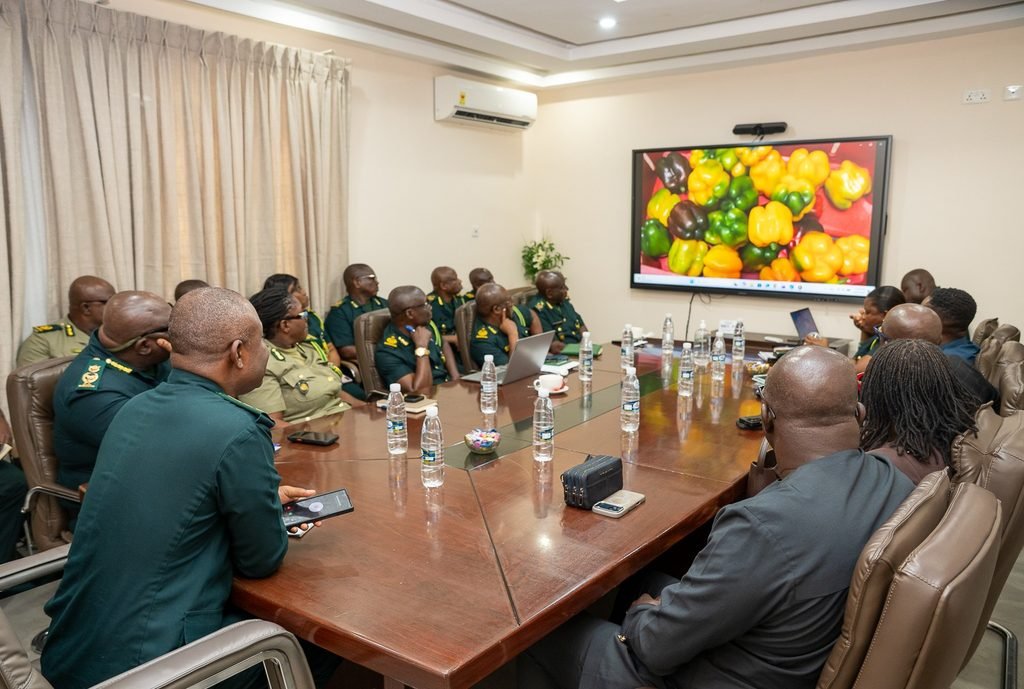
The company’s collaboration with the Ghana Armed Forces on poultry production, he added, provided another example of how agricultural production could be integrated into the operations of a security institution.
Dr. Acquaye further highlighted other agricultural projects being developed by Agri-Impact as potential areas of collaboration with the Ghana Immigration Service.
The partnership between the GIS and Agri-Impact comes as Ghana continues to seek innovative approaches to strengthening food production and reducing vulnerabilities associated with food supply and costs.
For the Immigration Service, the initiative presents an opportunity to convert its land resources into productive agricultural assets while reducing its reliance on commercial food suppliers.

A technical committee comprising representatives from the Ghana Immigration Service and Agri-Impact Limited has subsequently been established to advance the project.
The committee is expected to develop the framework for the initiative and work towards its implementation, including identifying suitable agricultural opportunities across the Service’s facilities and land holdings.
If successfully implemented, the GIS agricultural project could help lower the Service’s food bill, improve food supply to its personnel and facilities, generate additional economic opportunities and contribute to Ghana’s broader efforts to strengthen food security.