














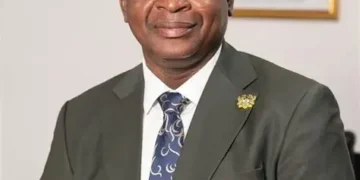






Ghana must strengthen its capacity to generate foreign exchange from its natural resources rather than continue relying on external financial assistance to address recurring currency pressures, according to an opinion article by Prince Kwame Minkah.
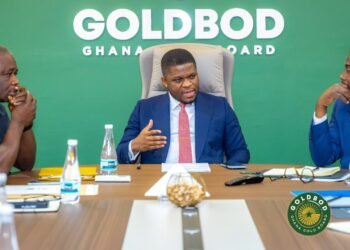
The article follows an announcement by the Ghana Gold Board (GoldBod) on November 2, 2026, that it generated US$1.011 billion from its Artisanal and Small-Scale Mining (ASM) gold trading operations in October.
According to the figures cited in the article, the entire amount was sold to authorised commercial banks through the GoldBod GoFX platform to support stability in the country’s foreign exchange market.
GoldBod is also projecting to generate US$1.2 billion in November, with US$800 million expected to be made available to commercial banks.
Mr Minkah describes the October performance as an important development in Ghana’s efforts to mobilise foreign exchange from its natural resources and strengthen the domestic economy.
He argues that GoldBod’s significance extends beyond purchasing gold from small-scale miners, noting that the institution provides a structure for organising the gold trade and channeling foreign exchange into the national economy.
He explains that making dollars available to commercial banks can help meet the foreign exchange needs of importers who require funds to purchase medicines, machinery, industrial materials and other essential goods.
However, he cautions that GoldBod’s interventions alone cannot guarantee an immediate appreciation of the cedi, as exchange rate stability also depends on fiscal discipline, import demand, debt management, productivity and investor confidence.
The article also calls for stronger public confidence in GoldBod through regular disclosures, transparent pricing, effective internal controls, independent audits and responsible management.
Mr Minkah maintains that while public institutions must be subjected to scrutiny, national economic initiatives should not be dismissed solely because of the political circumstances surrounding their establishment.
He argues that GoldBod should be strengthened and held accountable to ensure it delivers on its mandate, adding that its performance has implications beyond any particular political administration.
On the broader economic outlook, Mr Minkah calls for Ghana to build domestic mechanisms for generating foreign exchange and reduce its recurring dependence on external financial assistance, including programmes with the International Monetary Fund (IMF).
He stresses that this should not be interpreted as opposition to international financial cooperation, but rather as a call for stronger domestic economic resilience.
He identifies fiscal discipline, increased local production, industrialisation, value addition and reduced dependence on imported goods as necessary measures to complement GoldBod’s contribution.
The article concludes that the November projections and October performance are encouraging but should be assessed against the institution’s ability to deliver consistent, transparent and sustainable results.
Mr Minkah argues that Ghana’s natural resources must contribute more directly to reserve accumulation, currency stability, industrial growth and the country’s long-term economic independence.