





















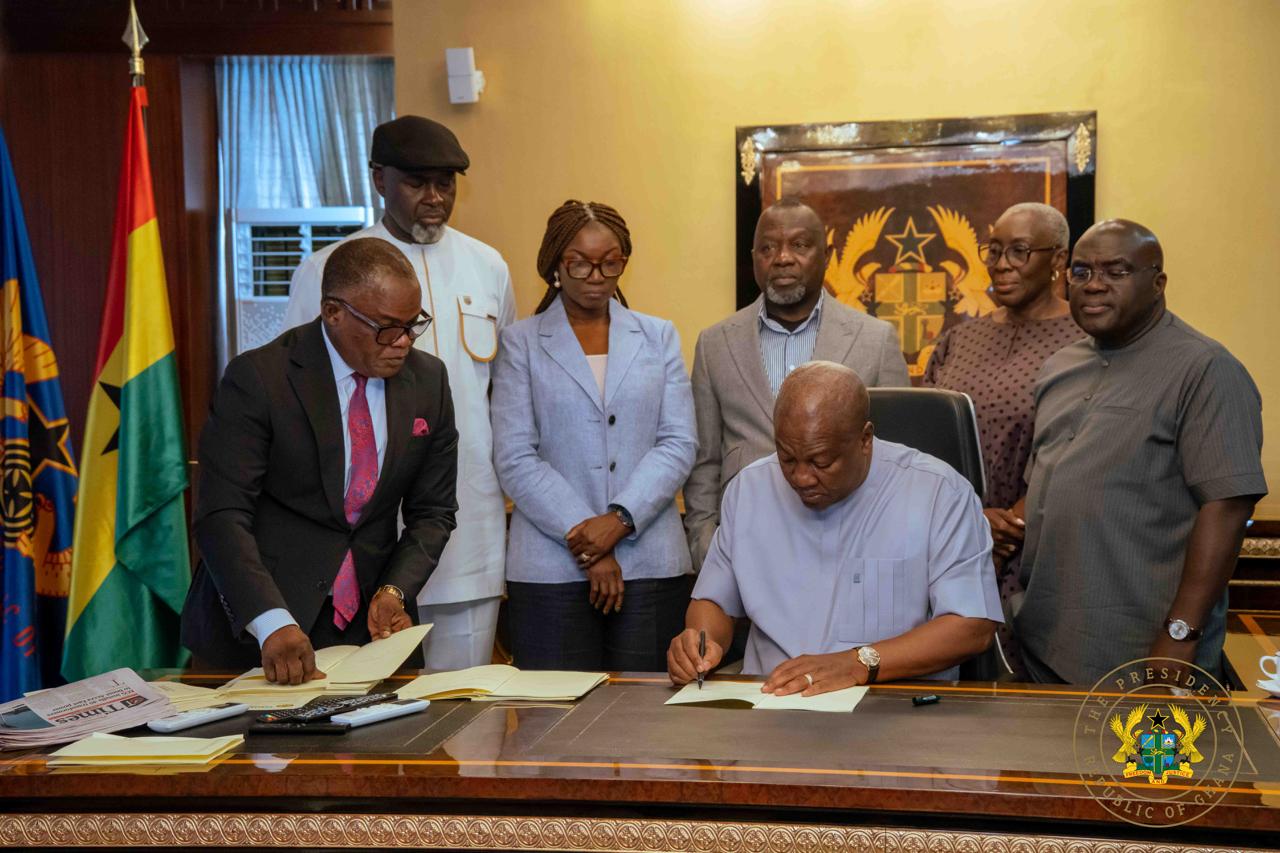
President John Dramani Mahama has signed five bills into law, introducing major reforms in Ghana’s security architecture, education sector, mining taxation, and financial protection systems.
The signing ceremony took place at the Jubilee House on Tuesday, March 31, 2026, and was attended by top government officials.
One of the key laws, the Security and Intelligence Agencies Act, 2026, abolishes the Office of the Minister for National Security and allows the President to assign oversight of security agencies to any minister.
President Mahama explained that the law also restores the original name of the National Intelligence Bureau, noting, “it also reverses the name of the office of National Intelligence Bureau (NIB), to the original name, Bureau of National Intelligence, (BNI).”
He added that the change is intended to resolve long-standing confusion between the intelligence agency and the National Investment Bank.
The President also assented to the University of Engineering and Agricultural Sciences Act, 2026, paving the way for the establishment of a new public university with campuses at Bonsu in the Eastern Region, Ohawu in the Oti Region, and Acherensua in the Ahafo Region.
In the mining sector, the Growth and Sustainability Levy (Amendment) Act, 2026, reduces the levy on mining companies from three per cent to one per cent following adjustments to the royalty structure.
Mahama explained, “it reduces it again to 1%, because of the introduction of the sliding scale of royalties.”
The Ghana Deposit Protection (Amendment) Act, 2026, expands financial safeguards by extending deposit protection to mobile money wallets and other digital financial platforms, moving beyond traditional banking coverage.
The President also assented to the Education Regulatory Bodies (Amendment) Act, 2026, which grants greater flexibility to private tertiary institutions and allows them to seek charter status.