

















The Upper East Region has declared itself open and ready for a full partnership with South Korea, with a call for technology, skills training, and industrial cooperation to transform agriculture and livelihoods in northern Ghana.
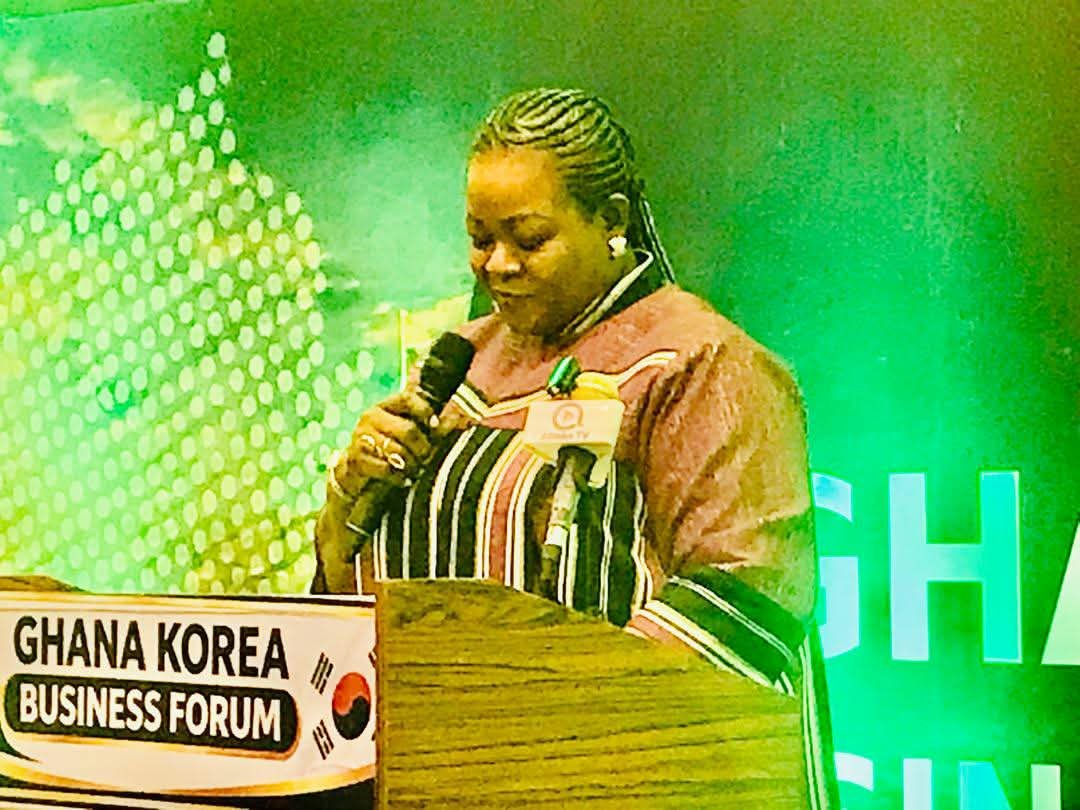
The message was delivered by Ms Anatu Bogobiri on behalf of the Upper East Regional Minister, Akamugri Donatus Atanga, at the Ghana-Korea Business Forum 2026 held at the La Palm Royal Beach Hotel in Accra.
Ms Bogobiri said the Regional Minister very much wanted to be present in person but pressing duties kept him in the Region.
“The Upper East Region is not only open to Korean partnership, it is ready for a Korean partnership!”
She thanked Mr Cheol Soo Lee and A-Tech Group Korea, the Daejeon Defense Industry Cooperative Association (DICA), and Digital Eye Africa Ltd for bringing a distinguished Korean delegation to Ghana, including retired Generals of the Republic of Korea Army and Air Force.
Ms Bogobiri said the relationship between South Korea and the Upper East did not begin on Wednesday.
Over the past year, the Regional Coordinating Council and A-Tech Group Korea have built a framework of cooperation covering drone and satellite technology, skills training, academic exchange, and the revival of agro-industrial assets.
These discussions have now been consolidated into a Memorandum of Understanding (MOU) between the Upper East Region and the Korean team, subject to approval by all relevant authorities.
At the heart of the programme is a partnership with Bolgatanga Technical University (BTU) to bring drone and satellite remote-sensing capability to northern Ghana, with the University of Technology and Applied Sciences (UTAS) in Navrongo as the second university partner.
“South Korea’s own story inspires us. Within one lifetime, Korea turned a war-torn, largely rural economy into a world leader in technology and manufacturing.
It did so by investing in people, in rural modernisation, and in the discipline to see long-term plans through.”
“The Upper East has the land, we have the people and now the plan.
What we seek from Korea is the know-how and partnership to move faster.”
The Upper East sits in Ghana’s far north-east, sharing borders with Burkina Faso and serving as a gateway into the Sahel countries and Togo.
It is home to about 1.3 million people across 15 districts and municipalities.
Most of the people are young, and most depend on farming.
The challenges are real: a single rainy season, rising temperatures, and land and water under pressure.
Much of what is grown leaves the Region raw, and value is added elsewhere.
To answer these challenges, the Region has adopted the PEARL Framework 2026-2035.
PEARL = Prosperity through Enterprise, Agriculture and Regional Livelihoods
It is a ten-year, GHS 8.6 billion plan covering all 15 districts, eight sectors and 23 flagship projects.
It was validated with chiefs, Assemblies, farmers, women’s groups, traders and the private sector in Bolgatanga this year.
PEARL rests on assets the Region already has:
- Three public irrigation schemes at Tono, Vea and Tamne for dry-season farming
- Agro-industrial assets ready for revival: Pwalugu Tomato Factory, Zuarungu Meat Factory, Pusu-Namongo cotton ginnery and Bolgatanga rice mills
- A strong livestock and guinea fowl tradition
- Gold resources around Talensi, to be managed responsibly
- The Paga border corridor, gateway to the Sahel market
Where Korean Technology Can Help
- Precision Agriculture and Drones
Farmers lose crops to drought, floods and fall armyworm, often before anyone knows the threat has arrived. Drones and satellite data can give early warning, map fields, and guide fertiliser and chemical spraying. The pilot will start on the Tono, Vea and Tamne irrigation schemes. - Geospatial Mapping for Planning
District Assemblies need accurate maps of land, settlements and property to plan better and raise their own revenue fairly. The same tools can map water sources and monitor land restoration after mining. - Water
Water is life in the savannah. The Region welcomes Korean expertise in water treatment, small-scale purification and efficient irrigation for drinking water and farms. - Skills
Technology only lasts when local people can run and repair it. The Region invites Korean partners to train young people through BTU, UTAS and technical institutes as drone pilots, technicians, GIS analysts, and professionals in cybersecurity and coding. - Industrial Cooperation
Korea knows how to run efficient factories. Korean companies are invited to look at idle agro-processing assets, starting with tomato, rice, meat and cotton. Each has buildings, land and community support already in place.
Ms Bogobiri added that drone and geospatial tools can also support national security agencies in border districts, under Ghana’s laws and in cooperation with national authorities.
What Upper East Offers In Return
The Region offers four things:
- A Clear Plan – PEARL
PEARL tells every partner what the Region wants and where each project fits. - One Door
The Regional Coordinating Council will be the single point of contact for Korean partners, opening the way to District Assemblies, traditional authorities and national agencies. - Accountability
The Region is setting up an independent PEARL Fund with its own Board of Trustees, a citizens’ oversight committee and published accounts. - People and Institutions
Two universities and a young population eager to learn and to work.
In return, the Region asks that partnerships build local capacity, create local jobs, transfer technology and respect the environment.
“We want projects that will still be running long after the ribbon is cut. We want legacy!”
Five Concrete Proposals
On behalf of the Regional Minister, Ms Bogobiri proposed:
- A drone and precision-agriculture pilot on at least one irrigation scheme, starting with Vea or Tono, in the next farming season.
- A skills and training centre at Bolgatanga Technical University for drone operation, maintenance and geospatial analysis, with UTAS as partner.
- A community water-treatment demonstration in at least one district, to be scaled across the Region.
- A Korean business delegation visit to Bolgatanga (date to be confirmed) to see irrigation schemes and agro-industrial sites first-hand.
- A joint working group of the Regional Coordinating Council, A-Tech Group and the universities to turn B2B discussions into signed project agreements.
The Region’s focal person for follow-up is Dr Bishop Akolgo.
Conclusion
“In the Upper East we have a saying that one hand cannot tie a bundle. Korea brings technology and experience; and the Upper East Region brings land, water, people and a plan. Together, we can tie this bundle.”
“Kamsahamnida. Thank you.”