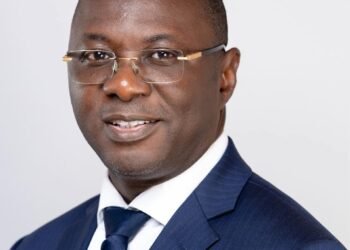










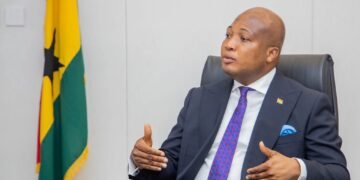







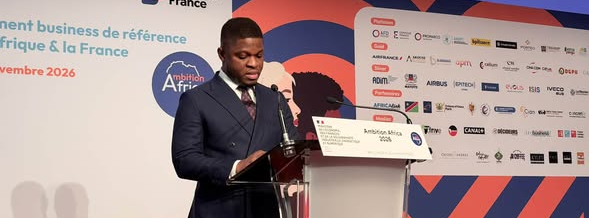
The Chief Executive Officer of the Ghana Gold Board (GoldBod), Sammy Gyamfi, has called on international investors to partner with African countries to develop local mineral processing, refining and manufacturing industries to ensure the continent derives greater economic benefits from its natural resources.
He said Africa must move beyond exporting raw minerals and focus on building industries that create jobs, transfer technology and retain more value within its economies.
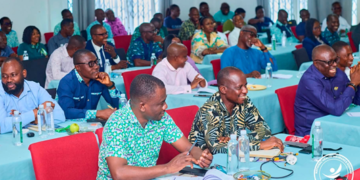
Speaking at the Ambition Africa event in Paris, France, on the theme, “Africa’s Minerals, Africa’s Future – A New Pact for Investment, Economic Transformation and Shared Prosperity,” Mr Gyamfi said the continent needed a new partnership with global investors based on what he described as “Fair Return for Fair Value”.
He said investors deserved competitive returns on their investments, while African countries also expected partnerships that would support industrial development, employment creation and shared prosperity.
Mr Gyamfi noted that although Africa was richly endowed with mineral resources, it continued to struggle to create sufficient economic opportunities for its growing youthful population.
He cited estimates that more than 400 million Africans were between the ages of 15 and 35, with 10 to 12 million young people entering the labour market annually, compared with only about three million formal jobs being created.
According to him, youth unemployment was not merely a labour-market challenge but also a production problem resulting from limited industrial capacity, insufficient value addition and inadequate long-term investment.
He argued that exporting raw minerals alone could not transform African economies, stressing that countries must assess their mineral wealth not only by the volume extracted but also by the industries and economic opportunities created from it.
Highlighting Ghana’s experience, Mr Gyamfi said the establishment of the Ghana Gold Board under President John Dramani Mahama was aimed at bringing Artisanal and Small-scale Mining (ASM) gold that previously escaped the formal economy into regulated channels.
He cited a SWISSAID analysis which identified a 229-tonne gap, valued at approximately US$11.4 billion, between Ghana’s reported gold exports and partner countries’ declared imports between 2019 and 2023.
He said official ASM gold exports increased from 63 tonnes in 2024 to 104 tonnes in 2025, generating approximately US$10.8 billion for the country.
He further stated that between January and October 20, 2026, the GoldBod had generated exports of 85.4 tonnes of gold, valued at US$11.6 billion.
Mr Gyamfi described the development as a “production clawback”, explaining that the GoldBod had not created new gold production but had helped bring gold previously lost through smuggling into the formal economy.
He said the initiative had become an important pillar of Ghana’s economic recovery efforts over the preceding 23 months.
The GoldBod CEO said fluctuations in international gold prices underscored the need for producing countries to build domestic capacity to retain more value from their mineral resources.
He maintained that while African countries could not determine international commodity prices, they could decide how much value to retain through local processing and industrial development.
He disclosed that approximately 27 tonnes of artisanal and small-scale mining gold had been refined locally in Ghana during 2026, while reforms undertaken through the GoldBod initiative had created about 5,000 direct jobs.
He also highlighted the Ghana Gold Souk initiative, which he said was intended to establish an industrial hub for jewellery manufacturing and fabrication.
Mr Gyamfi invited investors to partner with the initiative from 2027, adding that the GoldBod was also open to investments in responsible mining, mercury-free processing, refining, gold fabrication and trading.
He said such investments should support sustainable employment, technology transfer, skills development and long-term economic benefits.
Mr Gyamfi stressed that Africa could not achieve meaningful economic transformation without access to capital, technology, expertise and international markets.
He, however, cautioned that investment partnerships should not leave African countries confined to supplying minerals, land and labour while processing technologies and higher-value economic opportunities remained elsewhere.
He called for stronger Africa-Europe cooperation to develop integrated value chains that combine European capital and technology with African natural resources, skills and enterprise.
“Come and invest. Come and build. Come and earn fair returns. But let us create something greater together,” he told investors.
He said the long-term success of investments should be measured not only by the volume of minerals extracted or profits recorded but also by the industries, businesses, employment opportunities and communities developed.
Mr Gyamfi urged investors and African governments to work together to produce, process and add value to the continent’s mineral resources, insisting that the ultimate objective should be shared prosperity.