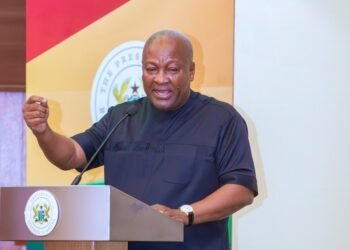






















President John Dramani Mahama has credited the establishment of the Ghana Gold Board (GoldBod) with improving foreign exchange retention from Ghana’s artisanal and small-scale gold mining sector.
He said the country received US$10.8 billion in foreign exchange from small-scale gold exports in 2025, compared with US$4.6 billion recorded in 2024, following the introduction of reforms to regulate the trade.
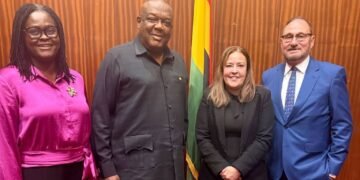
The President disclosed while interacting with members of the Ghanaian diaspora in Moscow, Russia, where he explained that the government established GoldBod to address gaps in the gold trading system.
He said gold was previously purchased by individuals and foreign buyers who exported the commodity, while the expected foreign exchange did not always return to Ghana.
“By April, we had passed the Gold Board Act, and it restricted the export of gold, because before anybody could come into our country, buy gold and take it out. And the forex normally didn’t come back,” he said.
Mahama said the government therefore focused on bringing the artisanal and small-scale mining sector into a formal system to ensure that gold production was properly recorded.
“In 10 of our regions, gold is produced, 10 out of 16. And so, one of the first things we needed to do was to formalise the artisanal small-scale gold sector and make sure that we accounted for every gold that was produced in that sector,” he stated.
He explained that GoldBod’s aggregation system had helped increase the quantity of small-scale gold officially exported, from 64 tonnes in 2024 to 104 tonnes in 2025.
The President also pointed to the corresponding rise in foreign exchange receipts, saying the country recorded US$10.8 billion in inflows in 2025.
“In 2024, we received 4.6 billion dollars for export of gold from the small-scale sector,” he said.
“And the inflow of foreign currency that came into Ghana was 10.8 billion dollars,” he added.
Mahama further warned against unauthorised gold exports, noting that the new legal framework provides strict penalties, including imprisonment, for people found exporting gold without authorisation.
The Ghana Gold Board Act, 2025 (Act 1140), established GoldBod as the central authority responsible for regulating the purchase, sale, marketing and export of gold and other precious minerals.
The legislation, passed by Parliament in March 2025 and assented to in April, gives GoldBod exclusive export rights over gold sourced from the artisanal and small-scale mining sector.
The reform is intended to formalise gold trading, strengthen oversight of the supply chain and improve the amount of foreign exchange retained from the country’s mineral exports.