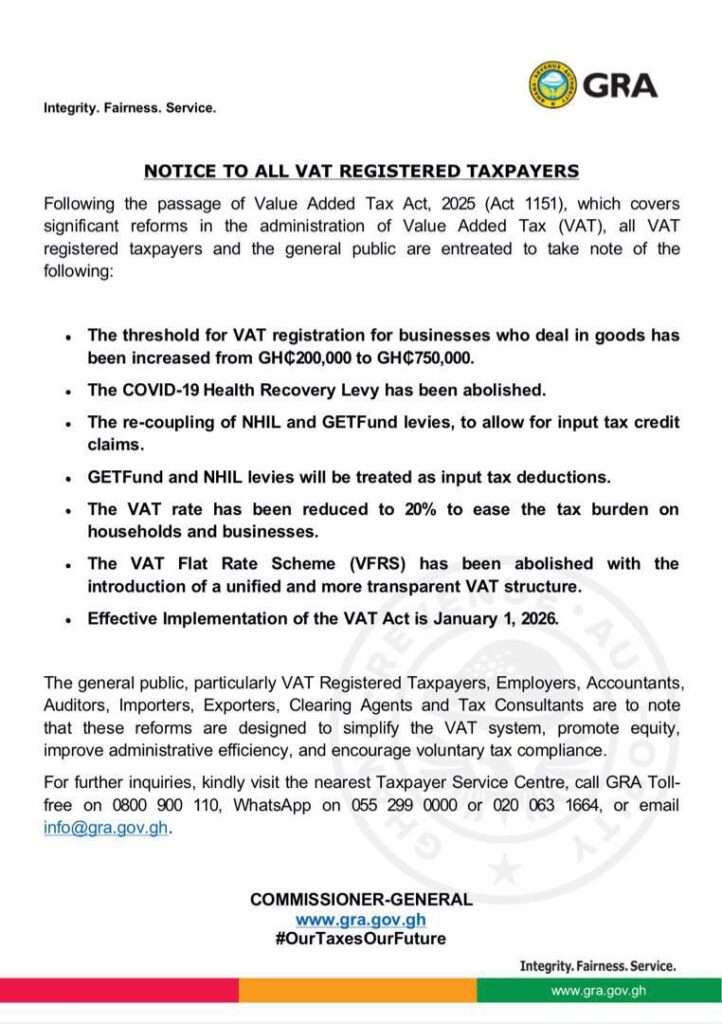
























The Ghana Revenue Authority (GRA) has announced sweeping reforms to the Value Added Tax (VAT) regime, set to take effect from January 1, 2026, following the passage of the Value Added Tax Act, 2025 (Act 1151).
The reforms are aimed at simplifying the VAT system, easing the tax burden on businesses and households, and improving efficiency in tax administration.
Under the new law, the VAT registration threshold for businesses dealing in goods has been increased significantly from GH¢200,000 to GH¢750,000, a move expected to reduce compliance pressure on small businesses.
In a major relief to consumers and businesses, the COVID-19 Health Recovery Levy has been abolished. In addition, the VAT rate has been reduced to 20 percent, which the GRA says is intended to make the tax system more equitable and supportive of economic activity.
The reforms also introduce structural changes to the VAT framework. The National Health Insurance Levy (NHIL) and the GETFund levy have been re-coupled, allowing taxpayers to claim input tax credits. Both levies will now be treated as input tax deductions.
Meanwhile, the VAT Flat Rate Scheme (VFRS) has been scrapped, paving the way for what the GRA describes as a unified and more transparent VAT structure.
GRA in a public notice stated, “The general public, particularly VAT Registered Taxpayers, Employers, Accountants, Auditors, Importers, Exporters, Clearing Agents and Tax Consultants are to note that these reforms are designed to simplify the VAT system, promote equity, improve administrative efficiency, and encourage voluntary tax compliance.
GRA advised taxpayers seeking clarification to visit the nearest Taxpayer Service Centre or reach out through its toll-free line, WhatsApp platforms, or official email channels.
Read below the statement