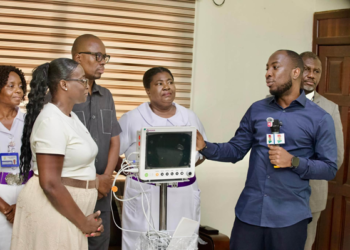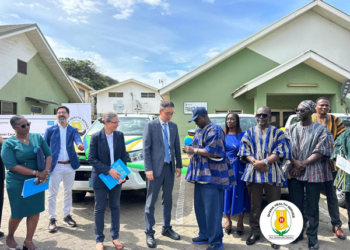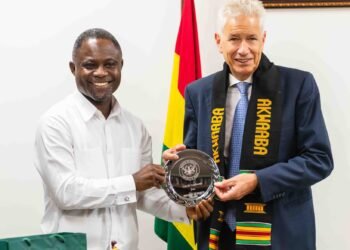










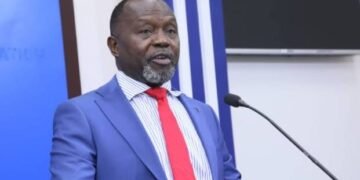


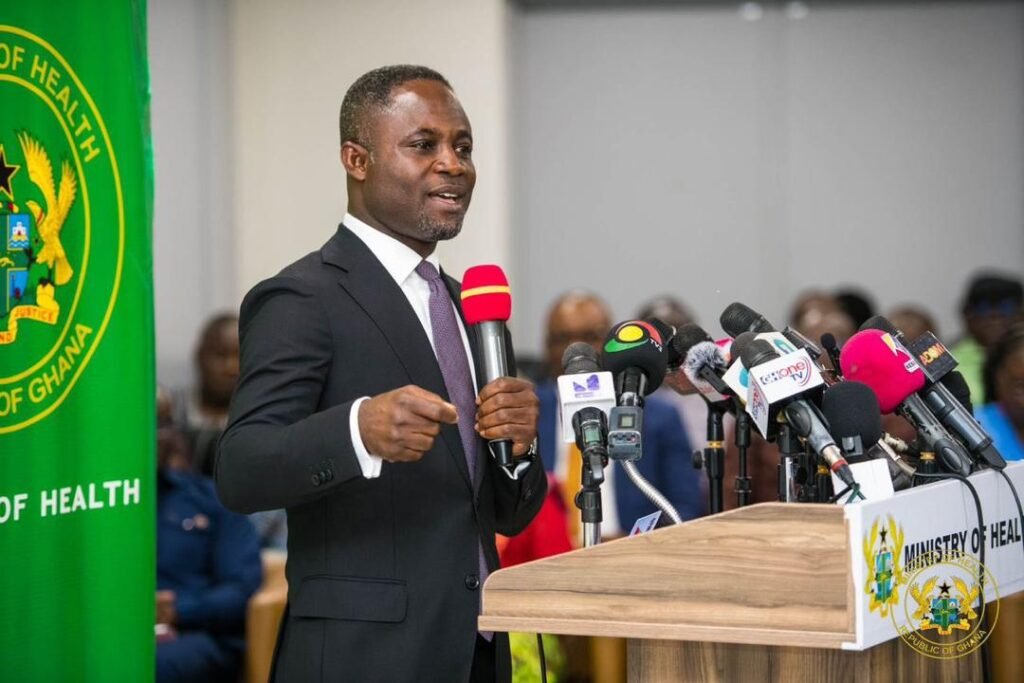
Health Minister Kwabena Mintah Akandoh has announced that Ghana’s Free Primary Healthcare programme is expected to cover every part of the country by the end of 2027.
According to the minister, the government is currently implementing the programme in 135 districts across all 16 regions, with plans to expand the coverage to the remaining districts in phases.
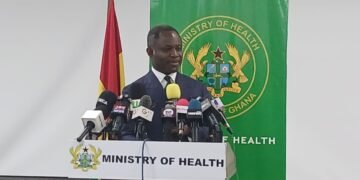
Speaking at a media briefing on Monday, September 7, Mr. Akandoh said the government was determined to move beyond the current phase and achieve nationwide coverage within the next year.
“It is our target that by the end of 2027, every part of this country should enjoy free primary health care.”
He said the government initially targeted 150 districts for the first phase of the programme and was working to reach that mark after successfully rolling out the initiative in 135 districts.
“We have done 135 in the 16 regions and we’ll be adding on to the 135 to arrive at the 150 districts.”
The minister explained that the first phase prioritised deprived districts across the country to ensure that communities with greater healthcare needs benefited from the programme.
“We started with the most deprived regions. The Upper West, Upper East, the Oti region, the Western North. That is where we started.”
The programme is currently being implemented in 4,574 health facilities nationwide, Mr Akandoh said.
These include 3,780 CHPS compounds, 746 health centres and 48 polyclinics.
The minister said the government’s approach was not simply to make healthcare available at health facilities but to fundamentally change how primary healthcare is delivered.
“What we are doing is putting quality health care at the doorstep of the economy.”
“Shifting where health care begins. We are now shifting it from the hospital to the community. And we now want to shift it from sickness to prevention.”
He said health workers were being trained to provide preventive and basic curative services within communities, including through home visits.
The programme covers treatment for common conditions such as malaria, respiratory diseases and diarrhoea, as well as preventive services including blood pressure, blood sugar, weight and selected cancer screening.
It also includes maternal and child health services, mental health support, nutrition, physical activity, hygiene, sanitation and healthy lifestyle counselling.
Mr. Akandoh urged Ghanaians to take advantage of the programme rather than waiting until illnesses become severe.
“Don’t wait till your condition gets worse because you don’t require any money to go to the hospital.”
He stressed that the Free Primary Healthcare programme was not intended to replace the National Health Insurance Scheme but would complement it by reducing the burden of preventable and advanced illnesses.
“The free primary health care is not a competitor to the National Health Insurance Scheme. And it does not come to replace the National Health Insurance, if anything at all.”
“The free primary health care is the cheapest friend of the National Health Insurance Scheme.”
The minister said the government’s ultimate objective was to make preventive healthcare a central part of Ghana’s health system.
The Free Primary Healthcare programme is a key component of the government’s strategy to strengthen primary healthcare and improve access to essential health services, particularly in underserved communities.
The initiative is designed to shift healthcare delivery from a predominantly hospital-based model to one that prioritises communities, prevention and early detection.
The government has so far rolled out the programme in 135 of Ghana’s 216 districts and has set an initial target of 150 districts.
The broader goal is to extend free primary healthcare to all parts of the country by the end of 2027.