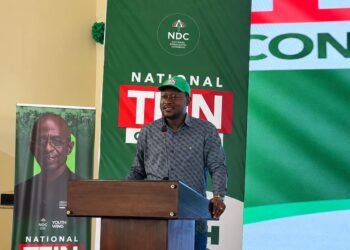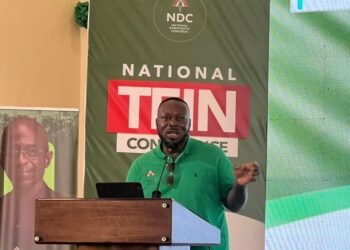






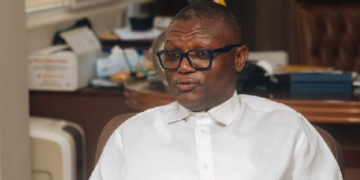







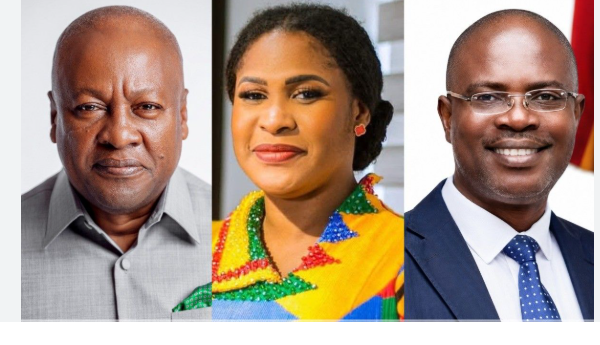
The Secretary General of the Ghana Federation of Labour (GFL), Abraham Koomson, has welcomed President John Dramani Mahama’s decision to intervene in the growing dispute between the Tema Metropolitan Assembly (TMA) and TDC Ghana Limited.
President Mahama has summoned the Metropolitan Chief Executive of Tema, Ebi Bright, and the Managing Director of TDC Ghana Limited, Courage Makafui Nunekpeku, to a meeting aimed at resolving the disagreement between the two state institutions.
The meeting, is also expected to be attended by the Minister for Local Government, Chieftaincy and Religious Affairs and the Minister for Sanitation, Works and Housing.
The Presidency has indicated that all parties are required to attend.
Speaking on Ahotor FM, Mr. Koomson described the dispute as evidence of poor coordination between the two institutions, warning that the situation could damage the government’s image and political fortunes.
He questioned how the TMA could issue development permits only for TDC to subsequently demolish structures covered by such permits.
“There is no mutual understanding between the two institutions. TMA will give a permit and TDC will go and demolish the structure. This is not good.”
Mr. Koomson urged the two institutions to work together in the interest of the state rather than operate as though they were pursuing separate agendas.
“It appears they are working for themselves or they don’t care about the fortunes of the government.
The enormity of the problems they are creating for the government is huge,” he said.
The disagreement between the TMA and TDC intensified following a confrontation over a development project at Community 1, Site 3, in Tema.
The project, involving the construction of shops and office spaces, is being undertaken by TDC on behalf of the government.
The TMA, however, maintains that the development was being carried out without the necessary planning and development permits.
On Wednesday, August 12, the Assembly, led by MCE Ebi Bright, moved to the site to halt the construction.
Portions of the contractor’s work and hoardings were subsequently demolished.
The action followed a response from TDC issued on August 10, in which the company sought to explain its longstanding institutional relationship with the Assembly and its role in the development.
Mr. Koomson criticised the use of bulldozers to demolish structures and called for greater engagement with residents and property owners before such actions are undertaken.
He proposed the use of town hall meetings to educate affected communities about planning requirements and explain why particular structures may be deemed unauthorised or inappropriate.
“There could be a town hall meeting to explain to the residents why a particular structure is inappropriate, instead of using a bulldozer to pull down people’s structures, especially in these difficult times.
It wasn’t like this in the past,” he said.
According to him, greater consultation would help prevent unnecessary confrontations and protect public confidence in state institutions.
Mr. Koomson commended President Mahama for stepping in to address the dispute and urged the leadership of both TMA and TDC to use the opportunity to find a lasting solution to their differences.
He warned that continued public disagreements between state institutions could undermine confidence in the government and create political challenges for the governing National Democratic Congress (NDC) ahead of the 2028 general elections.
“It is not good for the two state institutions to be behaving the way they are. This could affect the fortunes of the NDC in the 2028 elections,” he cautioned.
He called on the two institutions to put aside their differences, improve coordination and work together to protect government property, maintain public confidence and support the development of Tema.