












The New Patriotic Party (NPP) has taken the Attorney-General to the Supreme Court, seeking an interpretation of Ghana’s presidential term limits amid speculation over whether President John Dramani Mahama could seek a third term in office.
The party is asking the apex court to clarify whether the constitutional restriction of two presidential terms applies to a person’s total time in office, regardless of whether the terms are served consecutively or separated by a period out of office.
The legal action could have implications for debates over Mahama’s eligibility to contest the 2028 presidential election, although the President has publicly dismissed suggestions that he intends to seek a third term.
In its writ invoking the Supreme Court’s original jurisdiction, the NPP is seeking declarations on Articles 58(2) and 66(1), (2) and (3)(a) of the 1992 Constitution.
The suit, filed through the party’s solicitor, Godfred Yeboah Dame of Dame & Partners, names the Attorney-General as the defendant.
Among other reliefs, the NPP wants the court to declare that a person cannot be elected President more than twice and cannot hold the office for more than two four-year terms, whether consecutive or non-consecutive.
The party is asking the court to affirm that a person elected President “shall not hold office for more than two terms with each term consisting of four years (making a total of eight years), whether the two terms are consecutive or non-consecutive.”
It is also seeking a declaration that a person who has already served one presidential term “shall be eligible to serve as President for only one more term”, regardless of whether the two terms follow each other.
The lawsuit comes after renewed public discussion about whether the constitutional phrase “two terms” could be interpreted as permitting two consecutive terms rather than a maximum of two terms in total.
The NPP argues that an interpretation restricting the limit to consecutive terms could allow a former president who has served one term, lost an immediate re-election bid and later returned to office to serve two additional terms.
In its statement of case, the party strongly objects to that possibility, describing it as a threat to Ghana’s constitutional framework.
“Plaintiff considers this proposition not only absurd but dangerous for the democracy, peace and stability of the nation,” the statement of case reads.
The party further argues that interpreting the Constitution to impose a consecutive-term requirement would effectively introduce wording that does not appear in the relevant provisions.
“Acceding to this interpretation will condone and sanction manipulation of clear provisions in the Constitution as it involves inserting words into the constitutional text—it will involve amending the Constitution through judicial fiat,” the NPP states.
The party is therefore asking the Supreme Court to settle the issue through an authoritative interpretation of the Constitution.
The case follows speculation about whether Mahama could seek another term after his current tenure, despite his public statements that he does not intend to do so.
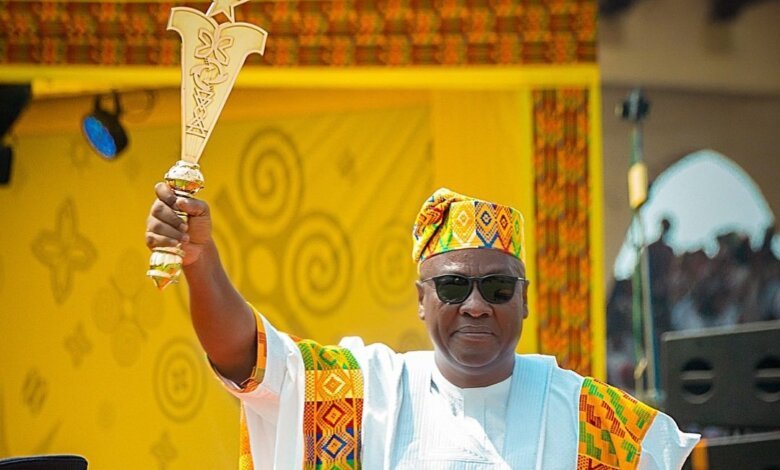
During his Resetting Ghana Tour of the Volta Region in July 2026, Mahama said his understanding was that the Constitution was clear on presidential tenure and reiterated that he had received a mandate for one additional term.
“The people of Ghana gave me a mandate for one additional term, and I’m going to work to meet the trust that they put in me,” he said.
The NPP’s legal action seeks to establish how the constitutional term limit should apply, irrespective of any individual president’s stated intentions.