

























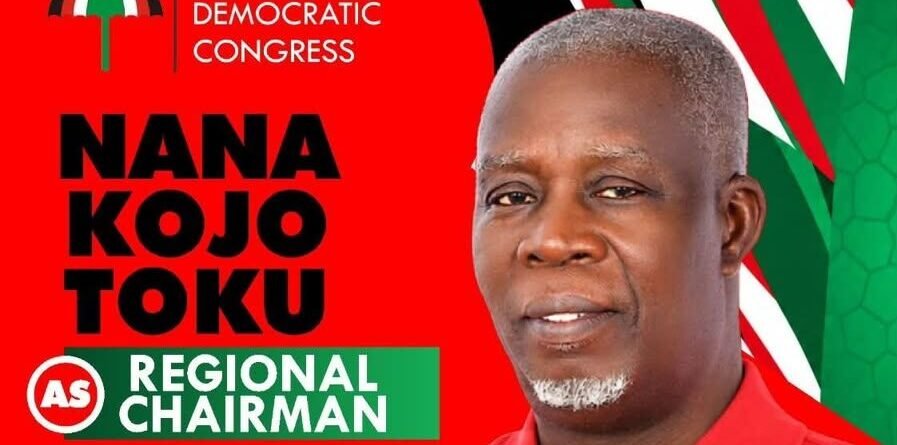
Members of the Apinto Royal Family in the Apinto Traditional Area of Wassa Fiase in the Western Region have petitioned the National Executive Committee (NEC) of the governing National Democratic Congress (NDC) over the continued occupation of the party’s Western Regional Chairmanship by Nana Kwabena Obo II.
The petition, dated October 28, 2026, challenges his eligibility to remain in the position and contest the forthcoming regional executive elections, citing constitutional provisions restricting chiefs from participating in active party politics.
The petition was filed by Ebusuapanyin Kweku Oduro, Head of the Apinto Royal Family; Mr Martin Anane; and Madam Regina Adjei, both members of the family.
Nana Kwabena Obo II, also known privately as Kojo Achempong and Nana Toku, is identified in the petition as the Akyeamehene of the Apinto Traditional Area, Awudua-Apinto, Wassa Fiase, and the current Western Regional Chairman of the NDC.
The petitioners allege that Nana Kwabena Obo II is a duly enstooled and gazetted chief who assumed the Akyeamehene stool on September 28, 2006, succeeding the late Nana Kwasi Akwaw II.
They further claim that his name appears in the National Register of Chiefs maintained by the National House of Chiefs, Western Region, under Serial Number 1135, with his traditional title recorded as Akyeamehene of the Apinto Traditional Area.
A certified extract from the register has reportedly been attached to the petition as supporting evidence.
The family argues that despite his recognised traditional status, Nana Kwabena Obo II has actively participated in partisan politics, currently serving as the NDC’s Western Regional Chairman while seeking another term in office.
The petition is anchored on Article 276(1) of the 1992 Constitution, which states:
“A chief shall not take part in active party politics; and any chief wishing to do so and seeking election to Parliament shall abdicate his stool or skin.”
The petitioners argue that the provision underscores the need to preserve the dignity, impartiality and neutrality of traditional authority.
They also reference Article 270(1), which provides constitutional protection for the institution of chieftaincy, and Article 277, which defines a chief by reference to valid nomination, election or selection and enstoolment, enskinment or installation in accordance with customary law.
The family, however, acknowledges that the express requirement for abdication under Article 276(1) specifically concerns chiefs seeking election to Parliament.
It says it is not asking the NEC to extend that requirement beyond its constitutional wording but wants the committee to consider the implications of a recognised chief’s continued participation in active party politics.
The petitioners are asking the NEC to investigate and determine Nana Kwabena Obo II’s traditional status and whether his political activities are consistent with the constitutional provisions cited.
They are also seeking his disqualification from contesting the forthcoming Western Regional Chairmanship election for as long as he remains a chief and the constitutional restriction is considered applicable.
Additionally, the family wants the NEC to consider his removal from the regional chairmanship if it determines, after due process, that his continued occupation of the position is inconsistent with Article 276(1).
Other reliefs sought include interim measures to prevent the regional electoral process from being concluded before the eligibility question is resolved, verification of his traditional status through the appropriate chieftaincy authorities, and written reasons for the committee’s eventual decision.
The petitioners have also requested that Nana Kwabena Obo II be formally notified of the complaint and given a reasonable opportunity to respond.
They have described the matter as urgent, given its potential implications for the forthcoming regional party elections.
The Apinto Royal Family says its action is not intended to undermine the institution of chieftaincy or the political rights of any individual.
Rather, it maintains that the petition is aimed at promoting constitutional compliance, protecting the sanctity of the Apinto Stool and safeguarding the integrity of the NDC’s internal electoral process.
Copies of the petition were also sent to the NDC National Chairman, National General Secretary, the Minister responsible for Local Government, Chieftaincy and Religious Affairs, the President of the National House of Chiefs and the President of the Western Regional House of Chiefs.