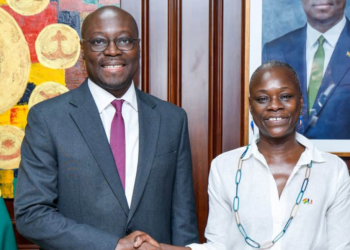




























Tensions are reportedly mounting at the Gaming Commission of Ghana following allegations that its Acting Commissioner, Emmanuel Siisi Quainoo, is lobbying influential government officials to secure the appointment of Patrick Kwakye, the Commission’s Deputy Director in charge of Investigations, Inspections and Enforcement (IICE), as his successor.
The development has reportedly triggered anger and disaffection among some staff of the Commission, particularly against the background of a new directive from the Office of the President requiring certain public office holders who have attained the compulsory retirement age to prepare their handing-over notes and vacate office.
Background to Siisi Quainoo’s Appointment
Emmanuel Siisi Quainoo was appointed Acting Commissioner of the Gaming Commission of Ghana by President John Dramani Mahama on January 22, 2025.
His appointment was communicated in a letter signed by the Secretary to the President, Dr Callistus Mahama, and took effect on the same day.
The appointment was made pursuant to Article 195(1) of the 1992 Constitution and Section 67 of the Gaming Act, 2006 (Act 721), pending the constitutionally required advice of the Commission’s governing board, in consultation with the Public Services Commission.
Interestingly, Mr. Quainoo is not new to the institution, having previously served as Commissioner of the Gaming Commission between 2014 and 2017.
However, his current leadership position has come under renewed scrutiny following the latest presidential directive on compulsory retirement and the alleged attempts to influence the next leadership of the institution.
In a letter dated November 23, 2026, and signed by the Secretary to the President, Dr Callistus Mahama, all Ministers of State were directed to ensure that Chief Executives of public institutions and state-owned organisations under their respective ministerial supervision strictly comply with the compulsory retirement provisions under Article 199(1) of the 1992 Constitution.
The directive emphasises that public officers are required to retire upon attaining age 60, except where the Constitution provides otherwise.
It further explains that under Article 199(4), retired public officers may be re-engaged for periods of up to two years at a time, subject to a cumulative maximum of five years.
The directive consequently requires Chief Executives who have attained age 60 and are serving without valid post-retirement contracts, or whose contracts have expired or reached the five-year cumulative limit, to submit their handing-over notes and vacate office.
It is against this backdrop that concerns are reportedly emerging within the Gaming Commission over what some staff perceive as an attempt by Mr. Siisi Quainoo to influence the choice of his successor before his eventual departure.
Sources at the Commission allege that the 64-year-old Acting Commissioner has been intensively lobbying for Patrick Kwakye, currently the Deputy Director of Investigations, Inspections and Enforcement, to be considered for appointment as the next Commissioner or to secure a position among the Commission’s leadership.
According to the sources, Mr. Kwakye was brought to the Gaming Commission by Mr. Siisi Quainoo from the Office of the Special Prosecutor, where he reportedly worked with Kissi Agyebeng.
Some sources have also raised questions about Mr. Kwakye’s alleged political affiliations, describing him as a known sympathizer of the New Patriotic Party (NPP).
Further allegations by individuals familiar with the Commission suggest that Mr. Siisi Quainoo and Mr. Kwakye wield considerable influence over administrative and operational decisions at the institution.
The situation, according to sources, has contributed to growing resentment among some employees, who accuse the two individuals of creating an uncomfortable working environment and subjecting staff to what they describe as unfair treatment.
The disaffection is reportedly deepening as some employees fear that the proposed succession arrangement could entrench an existing power structure rather than provide an opportunity for fresh leadership and institutional reforms.
Meanwhile, sources at the Jubilee House claim that Mr. Siisi Quainoo has made several visits to the Secretary to the President, Dr. Callistus Mahama, in an alleged effort to persuade him to consider Mr. Kwakye for an acting appointment when he leaves office.
The alleged lobbying has raised questions about the transparency of the succession process and whether the appointment of a new Commissioner will be based on merit, institutional requirements and the relevant appointment procedures.
For some staff, the central concern is not simply who succeeds the current Acting Commissioner, but whether the next leadership of the Commission will restore confidence, improve staff relations and ensure that the institution operates in the interest of the public.
The Presidency’s directive has therefore brought renewed attention to the leadership transition at the Gaming Commission, with employees reportedly watching closely to see how the government handles the impending change.
The Gaming Commission, as a key regulatory institution, is expected to maintain high standards of transparency, accountability and professionalism in the discharge of its mandate.
The Overseer Newspaper understands that questions surrounding the alleged lobbying and the reported treatment of staff are likely to become central issues in the unfolding leadership debate.
Mr. Siisi Quainoo, Mr. Kwakye and the Gaming Commission are yet to publicly respond to the specific allegations contained in this report. Their responses will be important in establishing the full circumstances surrounding the controversy.