





















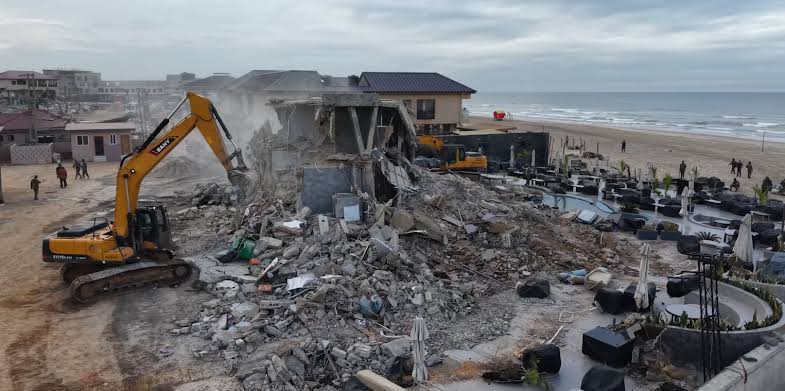
The Post Flood Mitigation Task Force and the Greater Accra Regional Security Council (REGSEC) have clarified that Sunday’s enforcement exercise at Laboma Beach was not intended to demolish the entire Laboma community.
According to the authorities, the exercise targeted specific structures located within the natural water retention basin of the Kpeshie Lagoon and marked for removal to facilitate the dredging of silted sections of the lagoon.
The Deputy Chief of Staff, Operations, and Chairman of the Post Flood Mitigation Task Force, Stan Dogbe explained that the affected area historically served as a water retention basin for water flowing downstream towards the sea.
He said the basin had, over the years, been significantly encroached upon through the destruction of vegetation, reclamation and the use of solid materials, including large boulders, to create foundations for physical structures.
“The exercise targeted marked structures that needed to be cleared to allow for the dredging of the silted areas that were within the water retention basin, which in the past, held water flowing down into the sea,” he said.
The Chairman stressed that several other structures and businesses operating within the wider Laboma area were not affected because they did not fall within the specific scope of the Task Force’s mandate.
The enforcement exercise followed a directive issued by the Greater Accra Regional Security Council on August 6, 2026, after an inspection of the Laboma Beach enclave.
Occupants within an area identified by the authorities as a protected lagoon buffer zone were subsequently given 21 days to vacate.
The enforcement team also demolished a newly constructed wall along the Labadi-Teshie road.
Authorities said the wall had been constructed to block access to an area where vegetation had been cleared and filling with solid materials was ongoing.
The Kpeshie Lagoon has been identified as a critical intervention point under the government’s post-flood mitigation programme.
Authorities say years of illegal reclamation, sand filling and uncontrolled development have reduced the lagoon’s capacity to retain floodwaters.
They maintain that restoring the lagoon’s natural drainage and water retention functions is necessary to improve the flow of stormwater towards the sea and reduce flooding risks in surrounding communities.