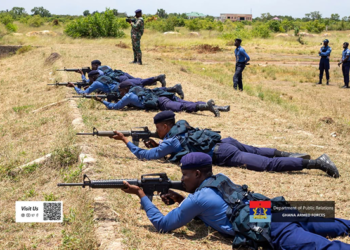
























Inspector-General of Police (IGP) Christian Tetteh Yohuno has been praised for what has been described as a renewed commitment to tackling armed robbery while improving the protection and preparedness of police officers responding to violent crime.
The commendation comes from a former police officer who recounted personal experiences of responding to robbery incidents and witnessing colleagues lose their lives in the line of duty.
According to the writer, the IGP and members of the Police Management Board (POMAB) have the ultimate responsibility to ensure that police officers are adequately protected and equipped to confront violent criminals.
“The duty of the IGP is to fight crime and make the life of responsible citizens safer and secured,” the writer said, stressing that effective policing also requires adequate protection for officers at the frontline.
The writer described robbery as one of the most difficult crimes for the police to combat, arguing that the crime has historically resulted in significant casualties among police officers.
“I have been in the frontlines myself and know how it is to return from scenes having had encounters with robbers,” the writer said, recalling periods when officers responded to robbery incidents with inadequate protective equipment.
The writer said the experience prompted him to publicly call for greater protection for police officers, including through open letters to presidents and other interventions.
According to the account, speaking out about the conditions confronting police officers came at a personal cost, including what the writer described as vindictiveness, victimisation and disciplinary actions over a period of 10 years.
The writer also said his promotions were delayed while colleagues advanced in rank and that he was repeatedly involved in legal battles to protect his career.
Recounting one particular encounter at the Police Headquarters, the writer said he met an individual referred to as “CT” after being paraded over an open letter to a president.
According to the writer, “CT” acknowledged that although there may have been concerns about the manner in which the issues were raised, the substance of the concerns was valid.
Years later, the writer said, he watched “CT” become IGP and observed what he described as a more aggressive police response to armed robbery than he had witnessed throughout his career.
He cited operations against dangerous robbery networks and said he was encouraged by the reported reduction in instances of police officers being killed while responding to robbery incidents.
“Today, there is motivation to fight robbery more than I have seen all my life in the police,” the writer said.
The writer, however, acknowledged that policing violent crime would continue to carry risks and that casualties could not be completely eliminated.
He argued that the priority should be to ensure that deaths among police officers in the line of duty are reduced to the barest minimum while providing officers with the equipment, protection and institutional support needed to protect the public.
The writer concluded by identifying “CT” as Christian Tetteh Yohuno and expressing confidence in his approach to combating armed robbery.
The comments come amid ongoing efforts by the Ghana Police Service to dismantle armed robbery networks and improve the operational capacity and safety of officers engaged in high-risk crime-fighting operations.