
























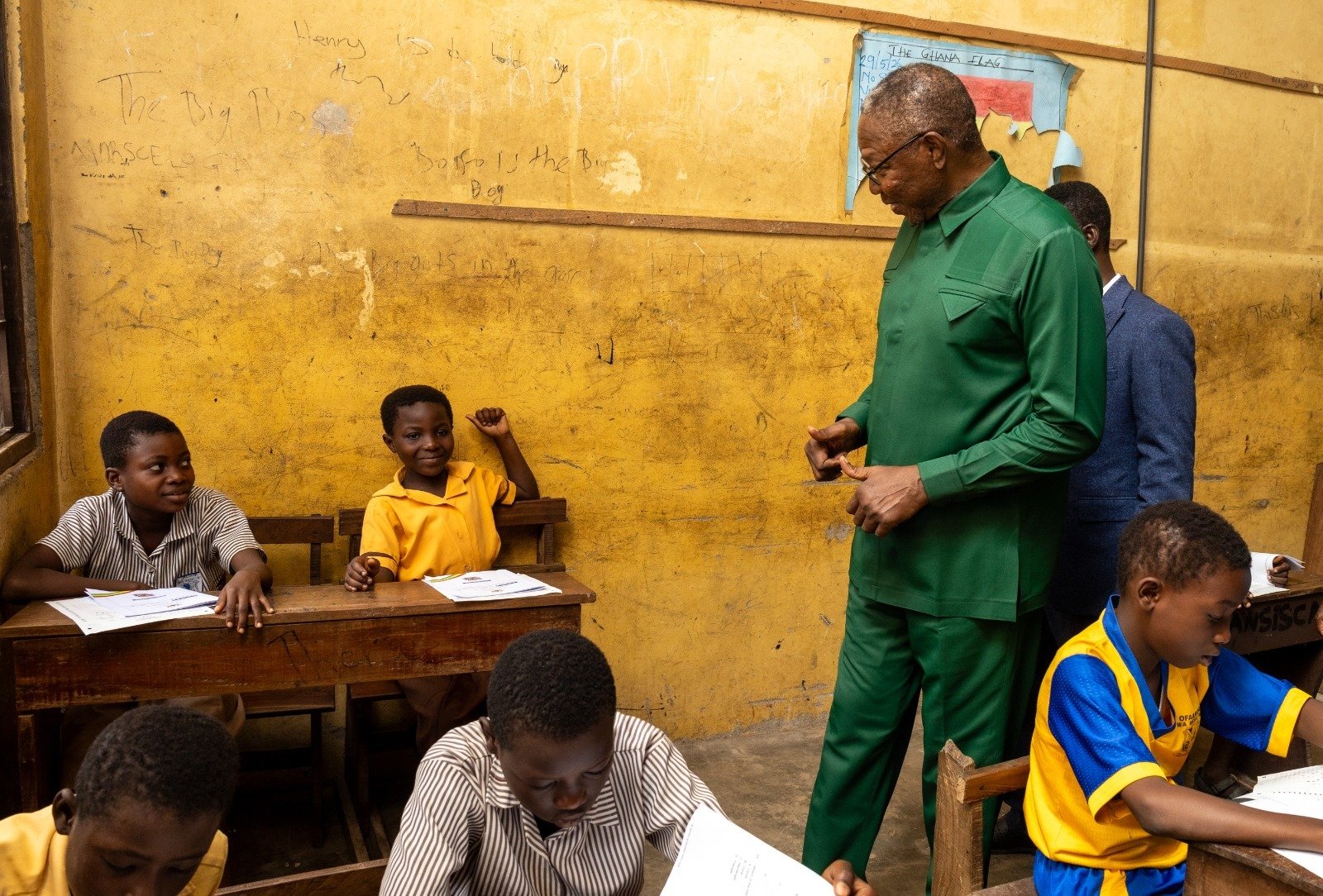
Deputy Minister for Education, Dr. Clement Abas Apaak, has clarified that the National Standardised Test (NST) is not designed to determine whether pupils pass or fail, but rather to identify learning gaps and provide the necessary support to improve academic outcomes.
Dr. Apaak made the remarks when he visited Nahadatu Islamic Basic School at Ofaakor in the Central Region to monitor the conduct of the assessment.
He also toured Akwale St. Mary’s Anglican Cluster of Schools and Ofaakor Municipal Assembly Basic School as part of a nationwide monitoring exercise.
The Deputy Minister was received in the Awutu Senya East Municipality by the District Education Director, Frank Etrue-Hayford, and officials from the Ghana Education Service, alongside heads of the various schools visited.
Speaking to Primary Four pupils before the commencement of the test, Dr. Apaak explained that the assessment would provide education authorities with vital information to improve teaching and learning.
“This exam is not about pass or fail. It is to help your teacher, to help us at GES and the Ministry understand how well you are doing in terms of the expectations for your standard Primary Four,” he said.
He noted that the results would enable teachers and education officials to identify pupils who require additional academic assistance and develop targeted interventions to help them meet expected learning standards.
Dr. Apaak stressed that pupils who may be found to need extra support would not be made to repeat their classes, but would instead receive the necessary academic interventions.
“Unlike the past, we are not going to say you should be repeated. Your teacher will identify those of you who need additional help, and then that additional help will be offered to you so that you will reach the level that has been set for Primary Four in terms of your curriculum,” he stated.
The Deputy Minister encouraged the pupils to remain calm during the examination, assuring them that their teachers had adequately prepared them.
“Don’t panic, take your time and answer the questions. I know your class teacher has prepared you well so you understand what to do,” he advised.
He further urged the pupils to develop critical thinking and problem-solving abilities, expressing confidence that they would play an important role in Ghana’s future development.
The National Standardised Test (NST), administered by the Ministry of Education, the Ghana Education Service (GES), and the National Council for Curriculum and Assessment (NaCCA), is aimed at assessing foundational literacy and numeracy skills among pupils.
The assessment covers pupils at KG2, Primary Two, Primary Four, and Primary Six levels, and is used to track performance, identify weaknesses early, and guide policies and interventions to improve learning outcomes across basic schools in Ghana