













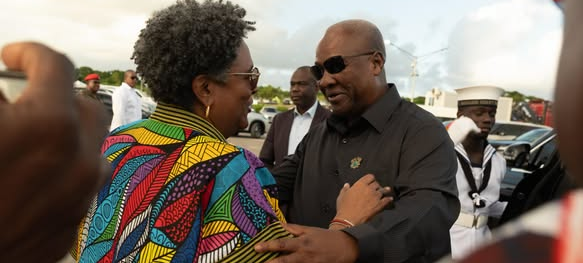
President John Dramani Mahama has joined the people of Barbados for the opening of the Newton Ancestral Memorial for the Enslaved, describing the site as an important reminder of the historical ties between Ghana and Barbados and the human cost of the transatlantic slave trade.
Speaking at the ceremony, President Mahama said the memorial stood on what is regarded as the largest and earliest known excavated communal plantation burial ground in the Western Hemisphere, where an estimated 570 enslaved Africans were buried.
He said the site, together with Ghana’s historic forts at Elmina and Cape Coast, provided important evidence of the suffering endured by Africans during the transatlantic trade in enslaved people.
“Here in Newton, we stand where many who lived under that system are buried. Together, these two places, Newton and the forts at Elmina and Cape Coast, bear witness to the human cost of the transatlantic trade in enslaved Africans,” he said.
President Mahama reflected on the journey of enslaved Africans who were taken from their homes through the dungeons of Elmina and Cape Coast before being transported across the Atlantic to plantations in Barbados.
He said the victims were separated from their families, stripped of their identities and deprived of their freedom, but their spirit endured despite the brutality of the system.
He stressed that understanding the full scale of the injustice required a connection between the historical sites in Ghana and the burial grounds at Newton in Barbados.
On behalf of the people of Ghana, President Mahama expressed gratitude to Barbados Prime Minister Mia Amor Mottley, President Jeffrey Bostic, and the Government and people of Barbados for their leadership in establishing the memorial.
He particularly commended Prime Minister Mottley for her commitment to preserving the shared history of Africans and people of African descent and advocating reparatory justice.
The President noted that Africans and people of African descent shared a common history and cultural connection that transcended oceans and national boundaries.
He expressed hope that the Newton Ancestral Memorial would serve as a permanent place of mourning, learning and healing while strengthening collective efforts to honour the memory of enslaved ancestors and defend the dignity of people of African descent.
The opening of the memorial marks an important development in efforts to preserve the history of enslaved Africans and deepen the historical and cultural relationship between Ghana and Barbados.