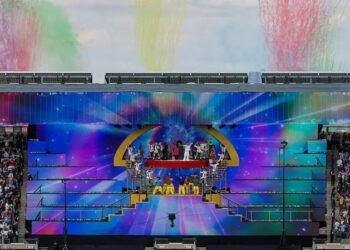



























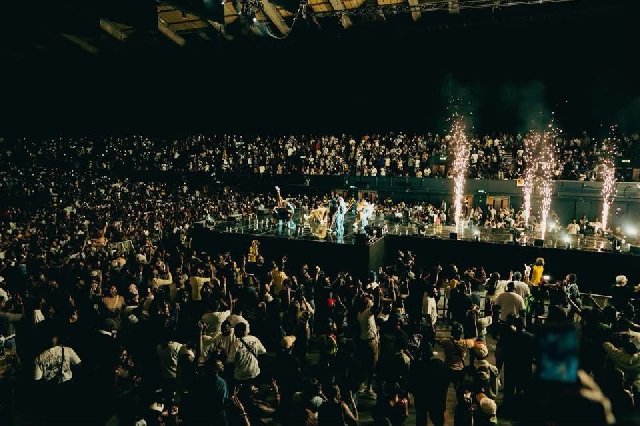
Ghanaian Afro-dancehall star Stonebwoy’s much-anticipated BHIM Festival UK at London’s OVO Arena Wembley has ended on a high note, with the artist delivering a strong performance alongside several leading Ghanaian and African musicians.
The concert, held on Saturday, August 15, 2026, was widely regarded as an important moment for Ghanaian music, with the venue promoting it as the first time a Ghanaian artist had headlined the OVO Arena Wembley.
However, amid the excitement and positive reviews, questions have emerged over whether the event actually reached the venue’s full capacity.
The OVO Arena Wembley has a stated capacity of approximately 12,500 people.
While videos and photographs from the concert showed a significant crowd, some sections of the venue appeared to have been covered with curtains, prompting speculation about the number of seats that were made available and ultimately occupied.
There could be several legitimate explanations for the configuration, including stage design, production requirements, venue management decisions or ticketing arrangements.
A definitive explanation, however, would have to come from the organisers or venue management.
The issue therefore is not whether BHIM Festival UK was successful, but whether the event should be described as a full sell-out if all 12,500 spaces were not available or sold.
Stonebwoy announced the UK edition of BHIM Festival in March 2026, giving organisers several months to promote the event.
The concert featured a star-studded line-up, including Samini, Ofori Amponsah, Kwabena Kwabena, DopeNation, Stylo G, Juma Jux, Tiwa Savage and Mr. P of P-Square, among others.
The combination of established artists, production and Stonebwoy’s headline performance helped create a major African music showcase in London.
A successful concert, however, does not necessarily have to be a sold-out concert.
If an artist sells 8,000, 9,000 or 10,000 tickets in a 12,500-capacity venue, that remains a significant achievement.
The important thing is for the industry to accurately report the figures rather than equating the venue’s maximum capacity with actual attendance.
The debate has renewed calls for greater transparency in Ghana’s entertainment industry, particularly when it comes to concert attendance and ticket sales.
Questions being raised include how many tickets were sold, how many people attended, how many seats were made available and what the final venue configuration was.
Such information, proponents argue, would provide a more accurate measure of the event’s success than photographs or videos alone.
The debate also touches on previous claims regarding the size of audiences at BHIM Festival events in Ghana.
Stonebwoy has previously discussed the scale of his concerts, including claims about filling a 50,000-capacity venue in Ghana.
The Accra Sports Stadium, which has hosted BHIM Festival events, is generally associated with a capacity of around 40,000.
However, a stadium’s maximum capacity does not necessarily represent the number of spectators that can be accommodated at a particular concert.
Stage positioning, production equipment, restricted areas and safety requirements can significantly reduce the space available to fans.
The discussion surrounding BHIM Festival UK should not necessarily be viewed as criticism of Stonebwoy.
Instead, it presents an opportunity for Ghana’s music industry to adopt more accurate and transparent measurements of success.
Ghana boasts some of Africa’s most talented musicians, and Stonebwoy has established himself as one of the country’s leading international acts.
Yet the industry continues to face questions about its ability to consistently mobilise large audiences in international markets, particularly when compared with the reach of some Nigerian artists.
Factors such as marketing, ticket pricing, diaspora engagement, strategic partnerships, venue selection and sustained promotion all influence the success of international concerts.
Despite the questions over attendance, Stonebwoy deserves recognition for taking BHIM Festival to one of London’s prominent indoor entertainment venues.
The ability to assemble a high-profile Ghanaian and African line-up, stage a major concert in London and deliver an event without major reported disruptions represents a significant achievement.
The focus now should be on obtaining clear figures that accurately reflect the night’s performance.
Rather than relying on appearances, Ghana’s entertainment industry can build greater credibility by celebrating the actual numbers—whether that is 8,000, 10,000 or the full 12,500 capacity.
Ultimately, the question surrounding BHIM Festival UK is not whether Stonebwoy achieved something significant. He did.
The question is simply: How many tickets were actually sold, and how many people attended the concert?
Clear answers to those questions would allow the achievement to be measured on facts rather than perception.