





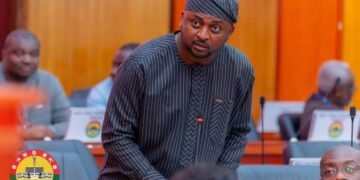
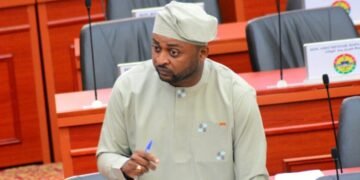










Former Minister for Lands and Natural Resources and Member of Parliament for Damongo, Samuel Abdulai Jinapor, has criticised the government’s 2026 Mid-Year Budget Review, describing it as a disappointing document that failed to address the key economic concerns of Ghanaians.
Speaking to journalists in Parliament after Finance Minister Dr. Cassiel Ato Forson presented the review, Mr. Jinapor said he had expected the statement to provide a comprehensive update on the implementation of major policy commitments contained in the 2025 Budget.
According to him, the review failed to adequately address critical issues such as unemployment, the rising cost of living and the progress of flagship government programmes.
He noted that the Finance Minister did not provide updates on initiatives including the proposed Women’s Development Bank, the Oil Palm Development Programme, industrialisation policies and the government’s flagship 24-hour economy agenda.
Mr. Jinapor argued that the primary purpose of a mid-year budget review is to account for the implementation of commitments made in the annual budget and inform Parliament and the public about progress made during the first half of the fiscal year.
He maintained that the review fell short of that expectation, claiming it offered little assessment of the implementation of the 2025 Budget.
The Damongo MP further alleged that government had significantly underperformed in executing its expenditure plans.
According to him, although the government had projected spending about GHS90 billion, only approximately GHS60 billion had been disbursed, leaving a spending shortfall of nearly 30 per cent.
He described the situation as the weakest budget implementation since 2016, arguing that the expenditure gap had contributed to liquidity constraints within the economy.
Mr. Jinapor said the government’s inability to fully implement its spending plans has worsened challenges including limited money in circulation, rising unemployment and the high cost of living.
He concluded that the 2026 Mid-Year Budget Review failed to inspire confidence, insisting that Ghanaians deserved a detailed account of the government’s economic promises and the progress made in delivering them, rather than what he described as a repetition of previous budget statements.