











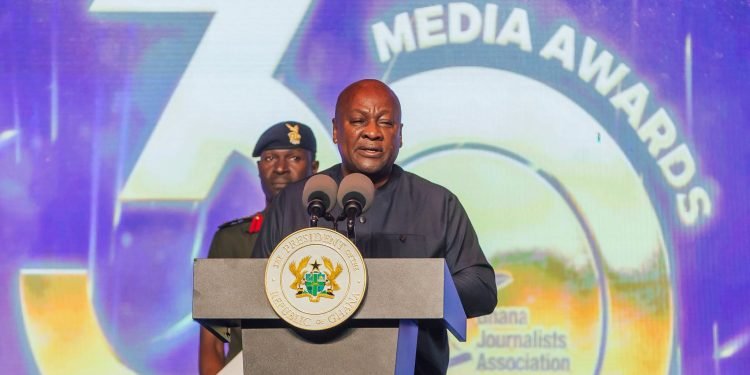
President John Dramani Mahama has warned journalists against turning routine scrutiny of government into what he describes as a deliberate hunt for scandals, insisting that facts and the public interest must guide media investigations.
He said journalists must avoid excessive confrontation with public officials, particularly where alleged discrepancies have not been properly established.
The President made the remarks at the 30th Ghana Journalists Association (GJA) Media Awards in Accra on Saturday, November 7, amid ongoing political debates over government expenditure and the management of public resources.
He took particular issue with journalists who publicly challenge ministers to appear on their programmes to answer allegations, arguing that such approaches could cross the line into adversarial journalism.
“We must also draw the line where journalism becomes adversarial,” he said.
Mahama maintained that his government would respect the media’s responsibility to question public officials but warned against what he described as splitting hairs in a deliberate search for scandals where none exist.
His comments come as the Minority in Parliament continues to demand explanations over the GH¢49.7 million spent on evacuating 1,964 Ghanaians from South Africa.
The opposition caucus has raised questions about the records covering the GH¢5,000 reintegration grant and GH¢500 transport allowance reportedly allocated to each evacuee, and has called for an independent audit of the exercise.
The Minority has also sustained its demand for parliamentary scrutiny of the reported US$1.7 billion loss associated with the Bank of Ghana’s Domestic Gold Purchase Programme, which was implemented through the Ghana Gold Board (GoldBod).
Minority Leader Alexander Afenyo-Markin has questioned the programme’s fee arrangements, discounted gold sales and the identities of the companies that purchased the gold.
The Minority argues that although the reported loss was attributed to the Bank of Ghana rather than GoldBod’s own accounts, the financial implications remain a matter of public interest and require parliamentary examination.
Ghana News Agency+1
Mahama’s comments therefore come against the backdrop of competing expectations about the media’s role in public accountability and the scrutiny of government institutions.
While the President insists that journalists should not manufacture controversies or pursue scandals without sufficient basis, the Minority maintains that questions surrounding public expenditure and the gold trading programme require transparent answers.
The President, however, assured journalists that his administration would uphold their mandate to hold government to account, stressing that legitimate scrutiny remained an important part of democratic governance.
The President’s remarks on adversarial journalism were reported following his address at the GJA awards, while the Minority’s concerns over the evacuation expenditure and GoldBod losses have been raised separately in Parliament and public statements.